
Italy is winning the recycling race on paper. On the streets of Bologna, however, we are losing the war against the smart bins.
According to official data, Italy is a star pupil in the European Union. We are reportedly already meeting most of the EU’s 2030 recycling targets. It sounds like a triumph of Mediterranean efficiency. But walk down any street in Bologna or Ozzano dell’Emilia, and the data begins to smell less like success and more like uncollected organic waste.
The culprit? A technological rollout by the waste management company HERA that proves the oldest rule in systems design: if you make a virtuous act difficult, people will choose the convenient vice.
The Era of Simple Sins
Until two years ago, the waste system in Bologna was analog and functional. We had the colorful row of giants: General Waste, Organic, Paper, Plastic/Cans, and Glass. If you had old clothes, frying oil, or a dead battery, there was a specific spot for it. You could even open a high-tech e-waste bin at the mall using your health card or tax ID.
It wasn’t perfect, but it mostly worked. You stepped on a pedal, the lid yawned open, and the trash went in. The only quirk was the Organic bin, which, for reasons known only to God and the authorities, required a physical key. It was a minor hurdle in an otherwise predictable chore. At some point, Italian pragmatism won, and people just attached that key with a piece of wire to the bin. Basta, problem solved.
The High-Tech Downgrade
Then came the “Smart” Revolution. HERA introduced bins that require a magnetic card to open. On paper, this tracks data and encourages separation. In reality, it has turned a five-second task into a battle of wills.
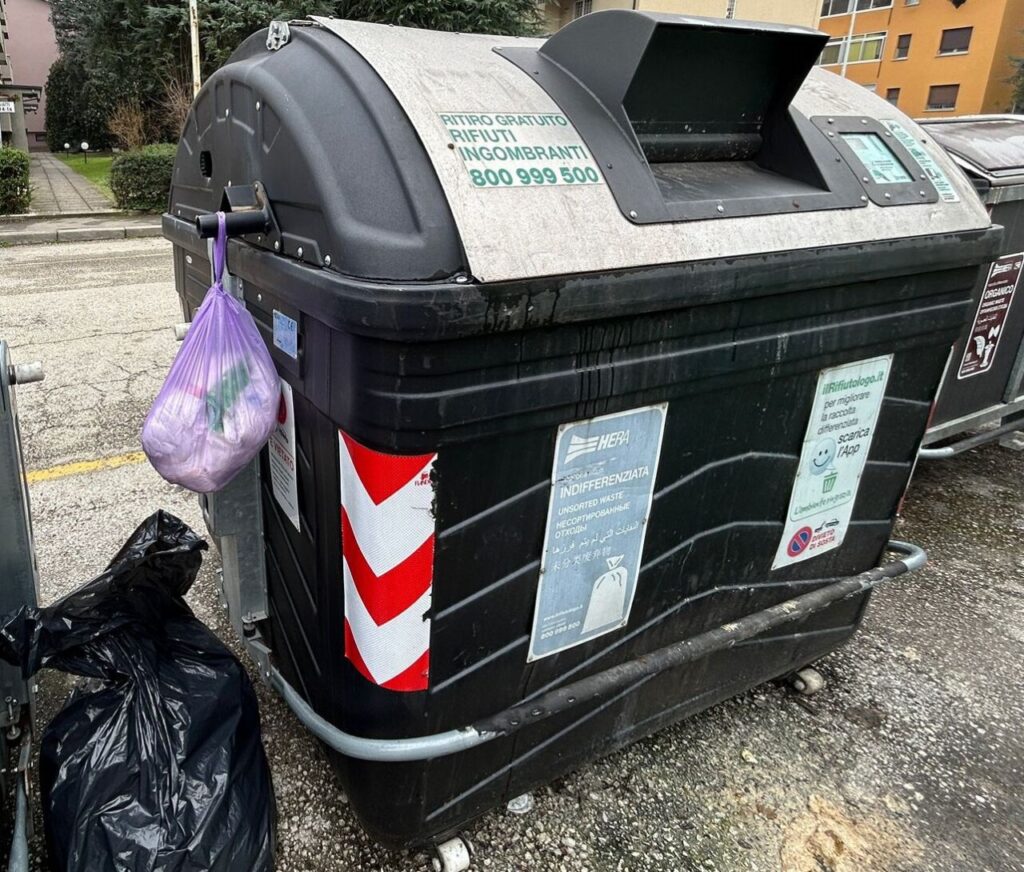
In Bologna, they changed only the General Waste containers. The old ones with the massive lids were replaced by a motorized aperture roughly the size of a microwave. To use it, you scan your card and wait. If you are lucky, the flap groans open a few inches. Usually, you have to use your hands to pry open the filthy, motorized metal to shove your bag inside. Then, you step on a pedal to dump it into the abyss.
There is a fatal flaw in this design: the opening is too small for a standard kitchen trash bag.
The intended consequence was to force people to separate more. The real-world consequence? The “Side-of-the-Bin” Phenomenon. When a bag doesn’t fit or the sensor fails, the bag doesn’t go home with the resident. It stays on the pavement. Or, more frequently, it finds its way into the Organic bin — the only one that still opens wide enough to accept a full-sized bag of life’s complications. The result is a contaminated mess that likely ends up in a landfill anyway, as it is impossible to realistically separate general trash out of a mountain of rotting organic matter.
Ozzano: The Barrier of Stupidity
Move a few kilometers away to Ozzano, and the situation becomes a slapstick tragedy. Here, every bin is now “smart.” The Organic bin works via foot pedal after a scan, but the Plastic and Paper bins are masterpieces of anti-user design.
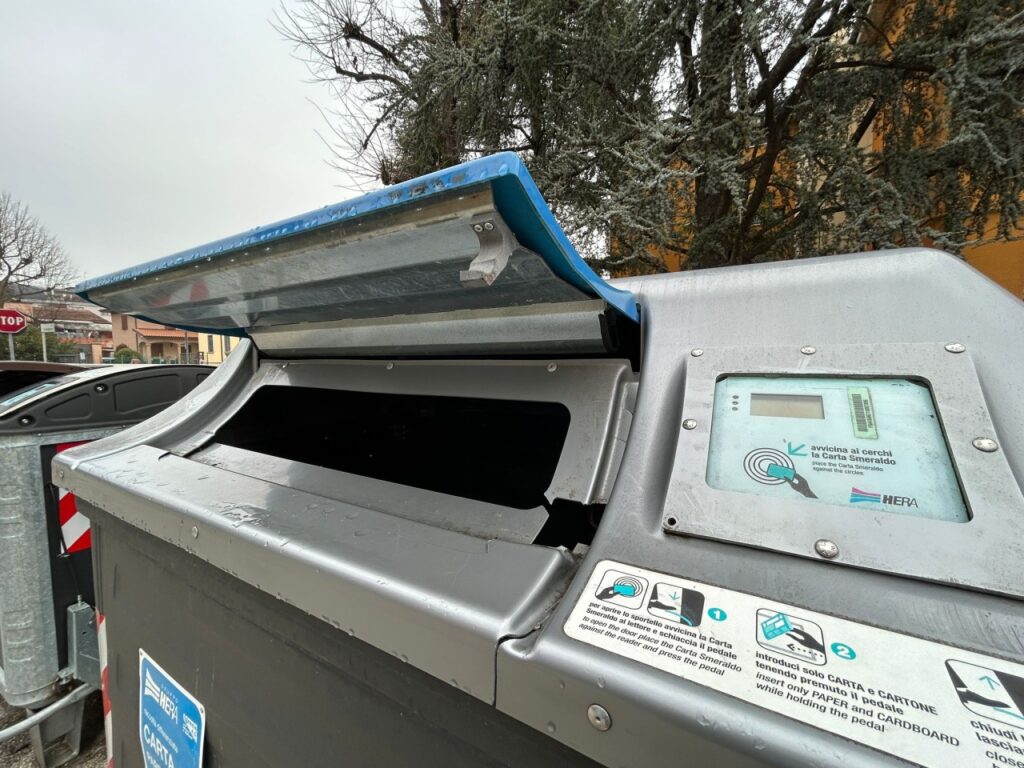
Once scanned, a large lid opens, but behind it lies a deliberate obstruction. For paper, a slit. For plastic, a narrow rectangle. You are expected to shred your cardboard and dismantle your plastic into individual pieces before disposal.
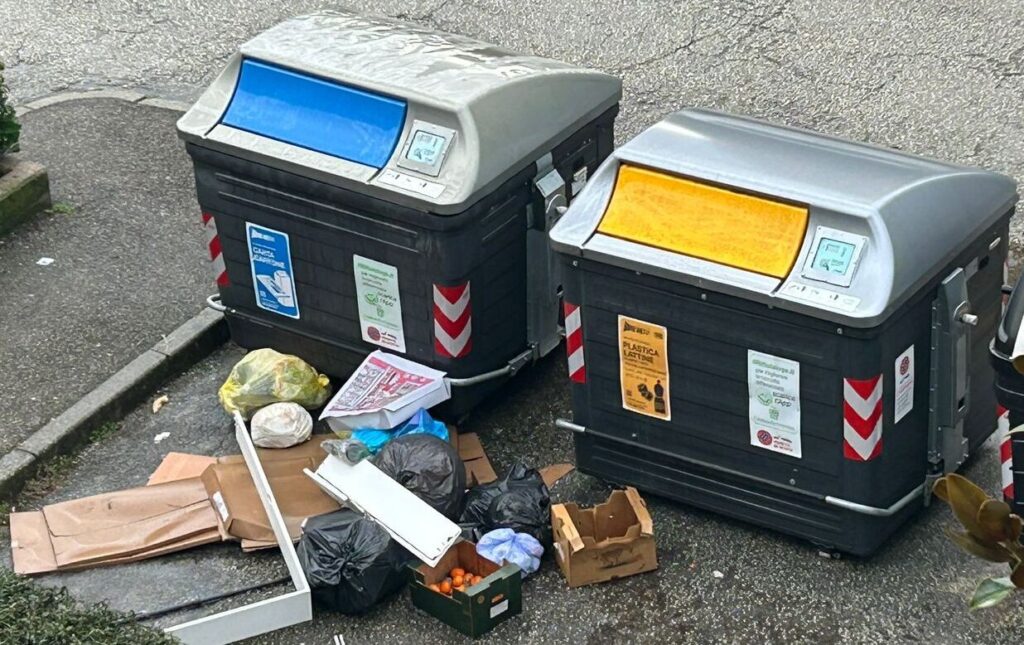
Human nature had a different plan. These flimsy plastic barriers have been smashed by residents trying to force their recycling through. Worse, the same leakage occurs: everything that is too frustrating to fit into the narrow slits ends up in the Organic bin or on the street.
The response to this “efficiency” is a daily clean-up van that follows the garbage trucks to pick up the piles left on the sidewalk. From tires to bags of unseparated plastic, it all goes into the back of a truck. This isn’t recycling; it’s a glorified, expensive way of moving litter from the sidewalk to a mixed-waste incinerator. The “Smart” bins are already dented, broken, or falling off the collection claws because they weren’t built for the rigors of the street.
The Wrong End of the Funnel
The fundamental error is that the system is trying to fix the problem at the end of the chain. They are blaming the consumer for having too much plastic while forcing them to buy it.
Walk through any Italian supermarket. You are trapped in a sea of non-recyclable polymers.
- Produce: Fruit and vegetables are suffocated in plastic trays and film.
- The Deli Counter: Meat and fish are sold in Styrofoam trays wrapped in plastic.
- Dairy: Milk comes in plastic bottles or Tetra Paks — a recycling nightmare of layered materials. There is exactly one brand of yogurt in glass, if you can find it.
- Hydration: Italy remains obsessed with bottled water. There is no glass-deposit system for households, only for restaurants. The tap water is often too chlorinated or chalky for the local palate, so the single-use plastic bottle remains king.
The only “green” concession is the compostable produce bag. But the gloves you must wear to touch the apples? Still plastic.
A Call for Radical Upstreaming
We don’t need smarter bins; we need dumber packaging.
If the legislator actually cared about the 2030 goals, they would stop installing card readers on trash cans and start enforcing bans on the factory floor. We need:
- A ban on multi-layered composite plastics used for meat — they are glued together and impossible to recycle.
- The end of the Tetra Pak until its actual recycling rate matches its marketing.
- A mandatory reusable system for milk, yogurt, and water.
- Compostable alternatives for every single supermarket tray.
- No more plastic packaging in disguise: The latest industry trend of producing plastic that feels and looks like paper. Only to end up in the wrong bin.
The best waste is the waste that never exists. Until we address the plastic tsunami at the supermarket, these new bins are just expensive, broken monuments to a failed philosophy. We are asking the citizen to be a chemical engineer at the curb while the industry remains a polluter in the aisle.