
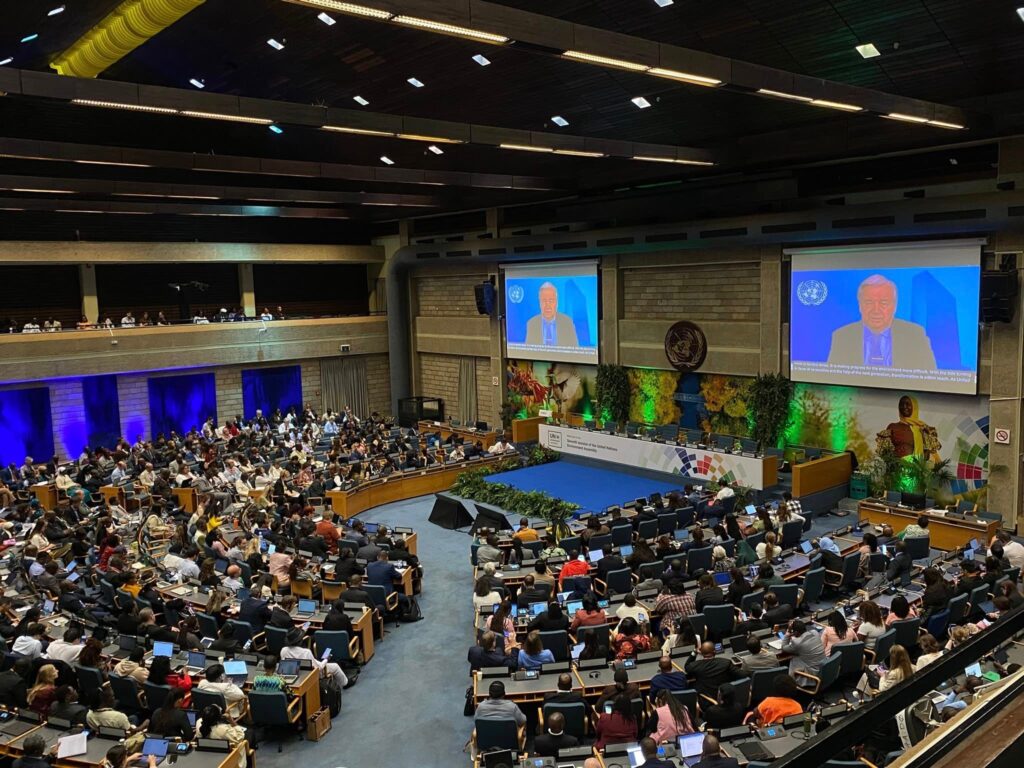
When I arrived in Nairobi in December 2025 as a delegate of the Children and Youth Major Group to UNEP, I carried with me a question I had been sitting with for some time. Not about policy positions or negotiating texts—those I had studied. The question was simpler and harder: what does it actually take for a young person to be present, substantively and credibly, inside a multilateral process?
By the end of UNEA-7, I had the beginning of an answer. And it has shaped how I think about the work ahead — in Central Europe, along the Danube, and across the interconnected spaces where climate action, democratic participation, and youth futures meet.
A mechanism built over decades
The Children and Youth Major Group to UNEP is one of nine Major Groups established through Agenda 21 at the 1992 Rio Earth Summit. That institutional origin matters. CYMG is not a youth event on the margins of a larger process — it is a formal governance mechanism, granting young people the right to engage with the UN Environment Assembly, the Committee of Permanent Representatives, and a wide range of multilateral environmental processes.
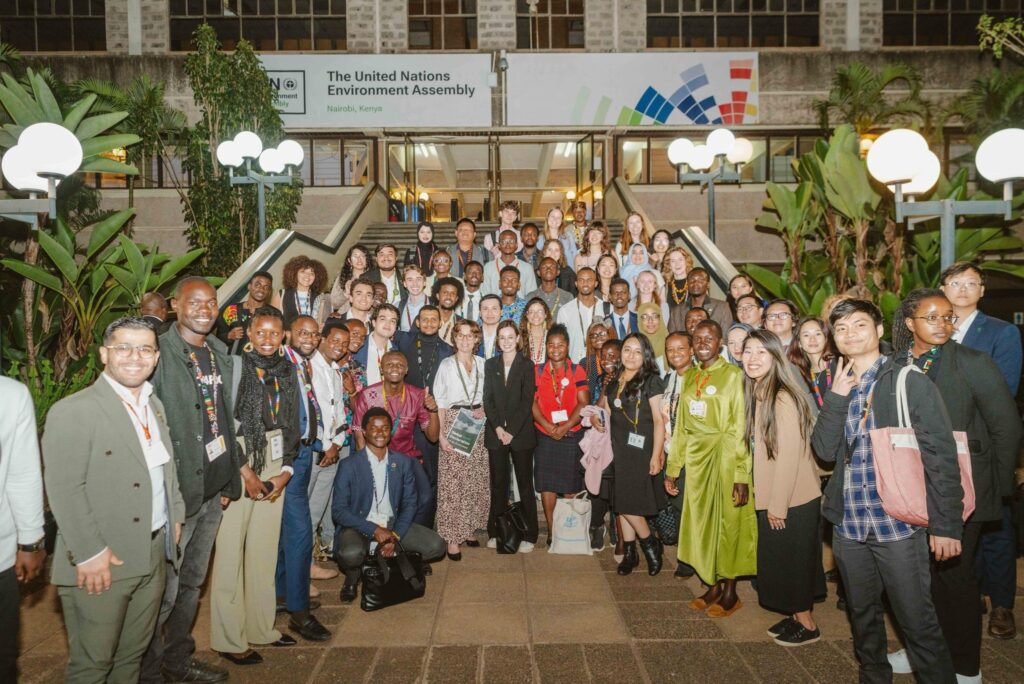
Children and Youth Major Group during the debrief with EU Commissioner Jessika Roswall at UNEP Headquarters, Nairobi – UNEA-7, December 2025.
By UNEA-7, CYMG had grown to represent over 2,000 organisations and more than 12,000 individual members across all six UNEP regions. In the months leading up to the Assembly, it facilitated, for the first time, youth policy consultations in every region — a process that produced the Global Youth Declaration on Environment, a consolidated document reflecting the priorities of young people from across the globe, formally presented to member states and UNEP leadership.
The declaration carried specific asks: intergenerational equity embedded into national climate plans, predictable funding for the Youth Environment Assembly, and full recognition of youth policy outputs as official inputs to UNEA processes. These are not broad aspirations. They are institutional recommendations, shaped through months of structured dialogue, and directed at the very architecture of how environmental decisions get made.
That is what three decades of sustained investment in a governance mechanism produces. And it is worth naming clearly, because it tells us something important about what comes next.
From access to co-shaping the future we want
There is a meaningful distinction between being present in a multilateral process and being part of shaping its outcomes. CYMG has spent years closing that gap — and the progress is real. At UNEA-7, youth delegates engaged not only in the plenary sessions but in committee negotiations, bilateral meetings with national delegations, and strategic discussions on the UNEP Medium-Term Strategy for 2026–2029. The session ultimately adopted a resolution on the meaningful participation of children and youth in environmental governance — a concrete institutional step, and one that CYMG had advocated for directly.
What this moment reflects is a generation that has done the work to earn its place — not symbolically, but technically. Young negotiators who understand procedural rules, who can read a bracketed text, who know when to build coalitions and when to hold firm on a core position. That knowledge is transferable. It is also teachable. And expanding access to it — across geographies, across economic backgrounds, across the range of communities most affected by environmental change — is one of the defining opportunities of this decade for European climate policy.
Programmes like the Youth Negotiators Academy and the Robert Bosch Stiftung’s Climate and Land Youth Negotiators Programme have demonstrated this in practice, placing trained young people inside official national delegations at major UN climate and environment conferences. These models point toward a future in which young Europeans are not only represented at negotiations but are active participants in them.
What the Danube teaches about the work
I came to this question through a particular place. Budapest sits on the Danube — a river that connects fourteen countries, runs through some of Europe’s most climate-vulnerable communities, and carries the lived realities of a region that is changing fast. Flooding patterns are shifting. Droughts are intensifying. Biodiversity in the river basin is under sustained pressure. And along its banks, young people are responding — monitoring water quality, contributing to urban resilience planning, connecting local environmental action to the wider European policy conversation.
The Danube Youth Climate Hub was founded to give that energy a shared infrastructure. A space where young people from across the basin could connect their knowledge, develop a common analytical language, and build pathways into the regional and European governance processes that shape the Danube’s future. The EU Strategy for the Danube Region and its associated youth engagement initiatives have created real openings in this direction — and the young people of the region have met those openings with seriousness and commitment.
What I have learned from that work is that the path from local civic engagement to formal negotiation is not automatic. It requires translation — not of language, but of register. Young people need to understand how EU cohesion funds flow, how macro-regional strategies are written, how a recommendation from a youth network becomes a line in a ministerial statement. That kind of policy literacy is what turns advocates into negotiators.
It is also, I should say, what makes multilateral institutions more legitimate. When a CYMG delegate speaks at UNEA and references conditions on the ground in a Romanian river town or a Hungarian flood plain, that is not anecdote. That is evidence. It is the kind of evidence that formal negotiation processes have historically lacked.
Looking forward
The work of building the next generation of climate negotiators is patient work. It requires institutions that stay committed over years, not cycles. It requires mentorship between those who have navigated these spaces and those who are learning to. It requires national governments and European institutions to see young people not as a constituency to be consulted, but as a cohort to be invested in — with training, with resources, with genuine roles in formal delegations.
UNEA-7 showed that the multilateral system is capable of taking these steps. The resolution on children and youth participation, the structured engagement between CYMG and senior policymakers, the presence of trained young delegates across negotiation tracks — these are signals of where the architecture is moving.
From Nairobi to the Danube, what I carry forward is a clearer sense of purpose. The decisions being shaped in multilateral rooms today will define the world that my generation inherits. The task is to ensure that, increasingly, we are among those shaping them.
Minh Trung Doan is based in Budapest, Hungary. He is the Founder and Coordinator of the Danube Youth Climate Hub, a Young Ocean Advocate within the Youth4Ocean Forum, and a CYMG delegate at UNEA-7. He serves as Local Ambassador for Hungary and Central Europe at United Citizens of Europe.