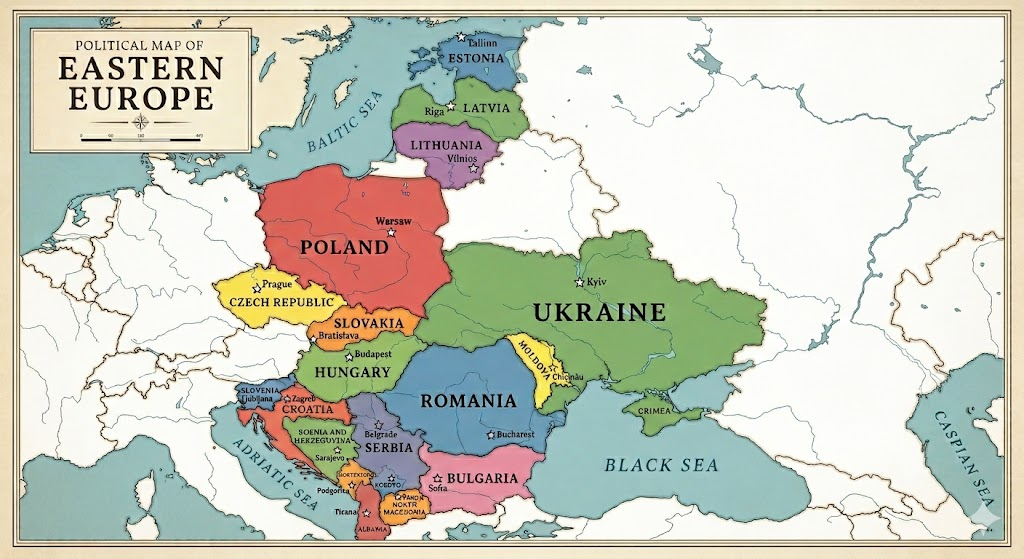
If, in the past, the world’s largest companies moved parts of their production to poor countries to maximize profits, we see that today this phenomenon is undergoing significant changes due to the geopolitical crises that countries have gone through in recent years. At any time, more ruptures between the power blocs in the world may appear, so companies are now looking for methods that not only bring the highest possible profit, as was the case until now, but also choose countries with predictability that are close to the political sphere of which they originate. One region that can benefit from this situation is Eastern Europe. Even if wages in the area have come closer to those in Western Europe, they still remain relatively low and can attract companies to hire the workforce necessary to carry out their operations. The advantage of this part of the world is that a good part of these countries are already members of the European Union or are making efforts to join, so their political system shows more trust than states whose situation may degenerate and thus produce instability for investors. Moreover, the geographical position brings a gain because it is neighboring richer areas, with larger consumer markets and which will reduce transportation costs.
There is already a term for this situation and it is called ‘Friendshoring’ and it assumes that Western companies do not only consider costs, but also geopolitical risk, and after the shocks to global supply chains caused by the pandemic and the war in Ukraine, businesses are certainly looking for predictability, especially in the context in which we see how relations between the EU and the US have cooled, and in the case of China we could expect an invasion of Taiwan soon. The phrase was coined by Bonnie Glick who first used the expression ‘allied shoring’ at the start of the pandemic while in 2022, U.S. Treasury Secretary Janet Yellen mentioned ‘friend-shoring’ in one of her speeches. Another reason why these countries can be chosen is the relatively low amount of taxes on companies, the fact that it would produce a lower Green Tax by reducing the length and duration of transport, but also because these states have a diversified energy segment, with solid investments in the production of renewable energy.
We can already observe these decisions in practice, citing examples of some companies and proving that this phenomenon is currently happening and producing effects. One example is Nokian Tyres from Finland which was forced by international sanctions to break its production chain in Russia with the start of the war in Ukraine. To avoid other similar situations, the company moved the majority of its production to Oradea, Romania, a member of the EU and NATO. Although they could have chosen a less developed country from Asia or South America, they preferred the stability and predictability of the Balkan state, but also the shared values this country offers, the latter part having an increasingly important role nowadays. Another example is the Japanese company Makita which reduced its production in China for the American market, and moved it to Romania to tariffs imposed by the United States. Poland has also attracted such moves by various companies such as Daikin and Mercedes-Benz that opened a factory in Jawor being 100% powered by renewable energy sources, avoiding EU penalties for car manufacturers that do not reduce their emissions throughout the production chain.
In order for this region to avoid the scenario where it is just a temporary step used in case of crisis, some measures are needed that must be taken carefully, but which will push countries like Romania and Poland to be winners of this deglobalization phenomenon. One solution would be to expand existing industrial parks, but also to build others, thus avoiding businesses spending years on all kinds of environmental approvals and authorizations. Moreover, renewable energy production must be increased to attract companies, especially in the automotive sector, which wants to avoid European Union taxes. The tax code must remain stable for at least 5-10 years, and here Romania has a negative look because it’s going through a period of financial instability, but it can recover by expanding the number of qualified people in various fields and can provide incentives to the industries of the future, not just those that are profitable at present. Also, the reconstruction of Ukraine will attract more investors to the region, and here it is necessary that the neighboring countries be as welcoming as possible to certain interested companies, for this an expansion of infrastructure is necessary. This phenomenon is not only about Western companies, but also about companies from China that have been investing in Hungary, for example, so the situation now also depends a lot on the political will of the countries that would like to profit from this unstable and unpredictable period of humanity.