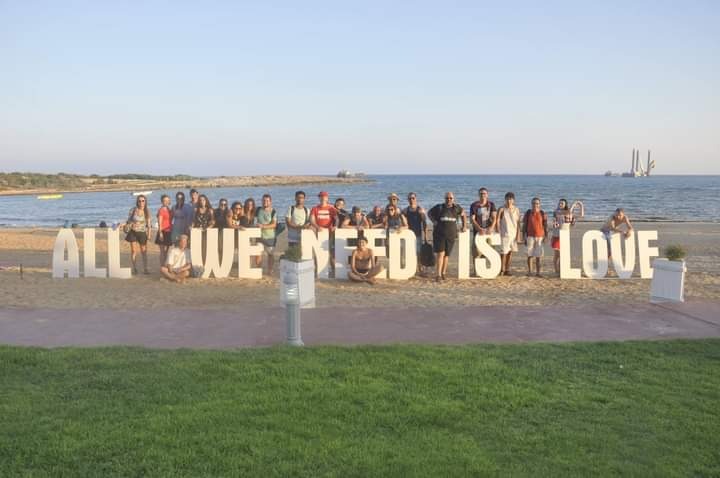
In the following article, I will describe the European Voluntary Service in the Youth4Sport2 project, which took place in Cyprus, from May to November 2017. The European Voluntary Service in Erasmus+ aims to develop solidarity and promote active citizenship among young people. During their stay of up to 12 months in the receiving country, young people contribute to social cohesion and considerably enhance their personal, professional, and intercultural competencies. The European Voluntary Service is carried out in partnerships between young volunteers, organizations in their country of residence, and organizations in a receiving country. Erasmus+ is the European Union’s programme for boosting skills and employability through activities organized in the fields of education, training, youth, and sport. Youth activities under Erasmus+ aim to improve competencies, skills, and employability of young people, promote young people’s active participation in society, their social inclusion and well-being, and encourage improvements in youth work and youth policy at local, national, and international levels.
The European Voluntary Service at Nautilos SAR/ OTI International in Nicosia, Cyprus, was one of the most meaningful experiences of my life. My role and tasks were to: work at the Café of the Youth Center, prepare and host radio shows, design and implement initiatives with the organization’s guidance, approval, and support, attend foreign language classes, promote the events and activities of the organization, report the weekly work, and reflect on the learning outcomes. As well I took part in training activities: On-arrival training: exchanging first experiences with regards to the volunteering projects, team building games, brainstorming, EVS learning service, foreign languages, intercultural learning and Mid-term meeting: group building games, presentations of EVS personal projects, info sessions, simulation of interview for workplace/studies, presentations of various alternatives regarding career, studies, entrepreneurship. The Youth4Sport project allowed me to work on ways and projects to get youth more physically active so they can have a healthier lifestyle: cycling, volleyball, basketball and other sport activities at the Youth Center, campaigns and events for promoting the organization and other volunteering initiatives, Radio Shows about: Keeping Fit, Youth Opportunities, Sports, What’s Up, Nutrition, language lessons, other workshops and co-organized youth exchanges. I got my diploma for successfully organizing Radio Shows and I will share with you a part of the topics: Climate change, Formal and non-formal education, Digitalization, Arts and culture, Studying, volunteering, internships and travelling, Healthy lifestyle and summer sports, Athletics and football, Physical activity and fitness, Sports and preventing diseases, Eating habits, Healthy foods and physical activity, Fat loss, Nutrition myths and healthy food.
In the first days upon arrival, I took some time to get to know my coordinators and colleagues, they were very friendly and really passionate about topics dedicated to youth. They had different professional paths, such as: volunteering with children with autism, biology, graphic design, music DJ or business but one passion for the Youth4Sport2 project.
My main guidance for learning was the EVS Learning Notebook. Every day I took notes regarding the activity as a volunteer. Since the beginning I set some goals: to improve my communication skills, to start a different lifestyle that includes a healthy diet and sports and to learn about the culture and civilization of Cyprus.
We participated in activities that required our creative abilities, such as role-playing, painting or editing, or learning words in a foreign language while listening to music, in order to gain a better understanding of the cultural features of Cyprus.
Regarding the other members of the EVS programme, I can say that we had a lot of similarities as European citizens but also different ways of expression. Although we expressed ourselves mainly by verbal and written communication, two of the colleagues were artists, namely a musician and a graphic designer and they mainly expressed themselves through art, helping us with music sets at the events or accomplishing tasks such as editing and creating digital art.
I usually dealt with issues related to budgeting when I had to plan my monthly grant for the expenses such as: food, beverages, cosmetics and personal care products, shoes, clothes or travel. I’ve also been part of a team exercise for which we were given a list of food items that we needed for breakfast and weekend meals and had to go at a local market to check the prices and budget the expenses in order not to exceed a certain limit.
During my stay on the island, I could observe the cultural characteristics of Nicosia, but also some aspects of my international colleagues from the Youth Center. While I was in the city center, I could admire art galleries with paintings, sculptures, antiquities or tailor shops and fashion boutiques. In my view, the Cypriots appreciate desserts, as I saw many pastries and sweets shops where the cakes looked like culinary art. I also saved time to visit other cities, namely: Ayia Napa, Larnaka, and Limassol. While in Nicosia, I used to spend most of the time cycling and running in the park, shopping, cooking lentils and chickpeas, joining rooftop parties, watching movies and seeing football matches in the city center. One of my favorite places in Nicosia was the Home for Cooperation, a unique community centre located in the middle of the dividing lines in Cyprus, in the Ledra Palace area, UN Buffer Zone, Nicosia. The Home for Cooperation has become a landmark building in Nicosia, acting as a bridge-builder between separated communities, memories and visions through its physical presence and its peace-building programs benefiting from the transformative power of arts and culture.
I believe the European Voluntary Service contributed to my growth. I became more independent and self-reliant. I can say that my learning objectives were focused on acquiring digital competencies and communicating in the English language. I observed progress regarding interpersonal, intercultural, and social competencies as well as cultural expression.