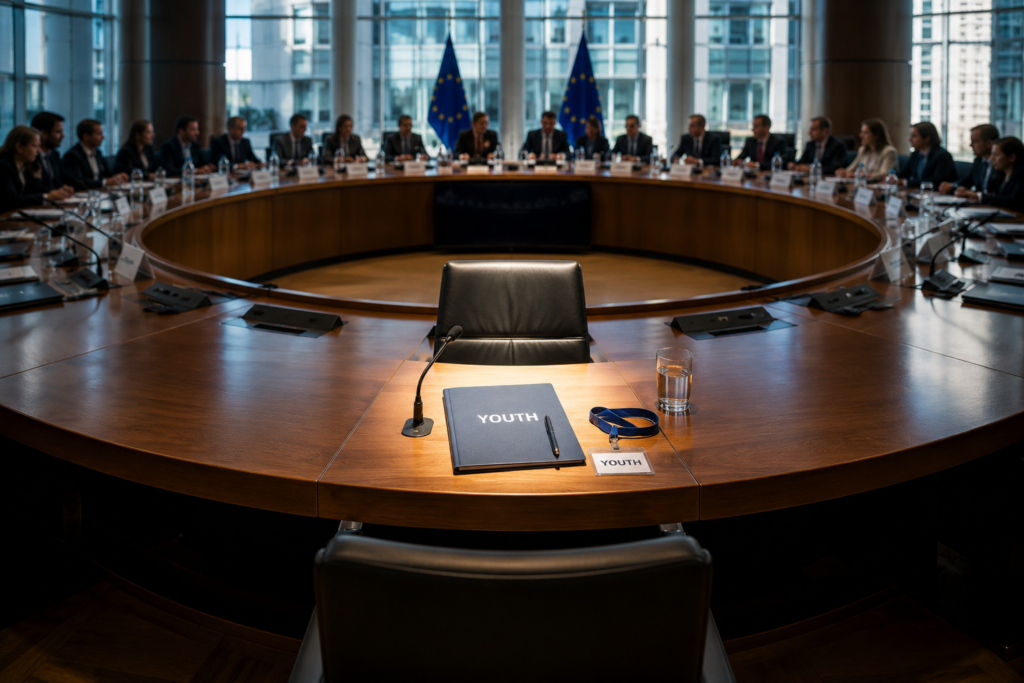
Every generation is told it is the future. Mine is still waiting for permission to become the present.
There is a sentence every young person in Europe has heard so often that we have stopped hearing it at all. You are the future. Politicians say it in campaigns. Schools print it on certificates. European institutions build entire strategies around it. It sounds like a compliment. Listen again and you can hear what is actually being said: not yet.
I still remember one meeting where a room full of adults asked a group of us what we thought about a decision that would affect our lives. We talked for almost an hour. We left convinced we had helped shape something. Then the months passed, and nothing changed. No feedback, no decision, not even a single line explaining why our ideas had gone nowhere. That was the day I understood that being invited into a room is not the same as being heard.
That meeting was not unusual. Europe has become very good at the appearance of listening. We are invited to youth forums, consultation panels, advisory boards and roundtables. We are asked what we think about climate, education, mental health and artificial intelligence. We are photographed. We are thanked. Then the adults return to the room where the vote happens, and we are not in it.
I do not say this from the outside. Through the Children’s Board of Romania, supported by UNICEF, and the Children’s Advisory Council of Bucharest, I have spent the last few years sitting opposite decision-makers who wanted to talk about young people’s lives. Sometimes those conversations changed something, and you could feel it in the room. Other times you could feel the opposite, the polite nodding, the notes nobody would reread. Every young person learns to tell the two apart within about ten minutes. We do not expect every idea to become policy. We expect to know whether anyone ever intended to use it.
Participation without influence is not participation. It is rehearsal. And it teaches an ugly lesson with terrible efficiency: that speaking and changing something are two unrelated activities. Once a teenager learns that, they rarely come back to argue. They simply stop coming.
If this sounds like a feeling rather than a fact, look at who actually holds power in Europe. Across OECD countries, people aged twenty to thirty-nine make up around a third of the voting-age population, but in 2022 only about a quarter of members of parliament were under forty, and just seven percent of cabinet members1. Youth is not a minority in Europe. It is a majority seated at the wrong table. The European Youth Forum adds that parties still place young candidates on the parts of the electoral list where nobody gets elected2, a quiet way of running down the clock on a generation while appearing to welcome it. Consultation without accountability is theatre, and Europe has been staging it for years.
Then there is the accusation people love to make about us, and I want to answer it directly. Young people are not apathetic. We organise climate campaigns, run volunteering networks, build social initiatives and talk openly about mental health and digital safety in ways the generation above us mostly avoided. We are already participating. What many of us have stopped believing is that institutions are participating back. Europe keeps asking how to make young people care more. The honest question is how institutions can get better at listening. Democracy does not fail when young people stop speaking. It fails when institutions stop listening.
So here is where I stop complaining and start proposing, because a complaint without a solution is just noise, and we have had enough noise.
First, stop measuring youth participation by how many chairs are filled, and start measuring it by how many decisions actually changed because young people were in the room. Every youth council and advisory panel in Europe should come with a published answer: which proposals were adopted, which were rejected, and why, within a fixed deadline. If an institution cannot be bothered to answer, it should not be allowed to publish the photograph. Second, test every law against the generation that will live under it longest. The European Commission has already floated age-based impact assessments as part of its youth work3. Make them standard, and make the results public. If a housing, climate or employment policy will make life measurably harder for people under twenty-five, that belongs on the front page of the file, not discovered by us fifteen years later.
Third, stop treating sixteen-year-olds as future citizens. Austria has let them vote since 2007. Malta lowered the voting age in 2018, and there a sixteen-year-old can even stand for local council4. Belgium and Germany opened European elections to them too, and no country collapsed. Voting at sixteen is not a cure on its own, and the turnout evidence is genuinely mixed, but it works far better when it arrives with real civic education and a first vote cast while you are still in school, still surrounded by people to argue with. Fourth, pay for participation. Right now, being a young voice in Europe usually means having parents who can afford the flights, the free afternoons and the unpaid internships. That is not a youth panel. It is a filter. Fund the travel and the time, and the young people Europe hears from will finally stop sounding exactly like the adults already in charge.
And before anyone reaches for the easy objection, none of this means handing the keys to teenagers and hoping for the best. It means judging our ideas by the same standard as everyone else’s, and acting on the ones that survive it. That is not a lowering of the bar. It is an invitation to meet it.
None of this is charity, and this is the part Europe keeps getting backwards. Youth participation is not a gift handed down to us. It is better decision-making. We live inside classrooms, not briefings. We live in the digital spaces most policymakers only visit to be frightened by. We face housing and job markets that many of the people designing them last entered thirty years ago. Ignoring that is not caution. It is throwing away information.
And the cost of getting it wrong is larger than any single policy. Democracy is not really built in dramatic moments. It is built in hundreds of small ones, in the first time a person discovers that something they said actually moved. A teenager who is ignored once may decide never to bother again. A teenager who is genuinely heard tends to volunteer again, vote later, and stay. That moment is far more fragile than adults seem to realise, and Europe is spending it carelessly.
Europe loves to say that young people are its future. I hope one day it stops saying it. Because the moment a generation is finally trusted to shape the present, it no longer needs reminding that the future belongs to it. The strongest democracies are not the ones that talk the most about young people. They are the ones where young people stop asking to be heard, because they have stopped needing to. That is the day the waiting ends.
Sources
1 OECD, Youth empowerment and intergenerational justice (2022 figures); see also OECD, Governance for Youth, Trust and Intergenerational Justice. https://www.oecd.org/en/topics/youth-empowerment-and-intergenerational-justice.html
2 European Youth Forum, Democracy and young people. https://www.youthforum.org/topics/democracy-and-young-people
3 European Commission, EU Youth Dialogue and youth policy. https://commission.europa.eu/topics/youth_en
4 OECD Youth Policy Toolkit, Reviewing minimum age requirements to vote and run as candidate in elections. https://www.oecd.org/en/publications/2024/11/oecd-youth-policy-toolkit_7ae28a3d/reviewing-minimum-age-requirements-to-vote-and-run-as-candidate-in-elections-austria-belgium-estonia-germany-greece-israel-italy-korea-lithuania-mexico-and-turkiye_bb0da4f8.html