What better way to sop their dissatisfaction than to throw money around?
A grant call
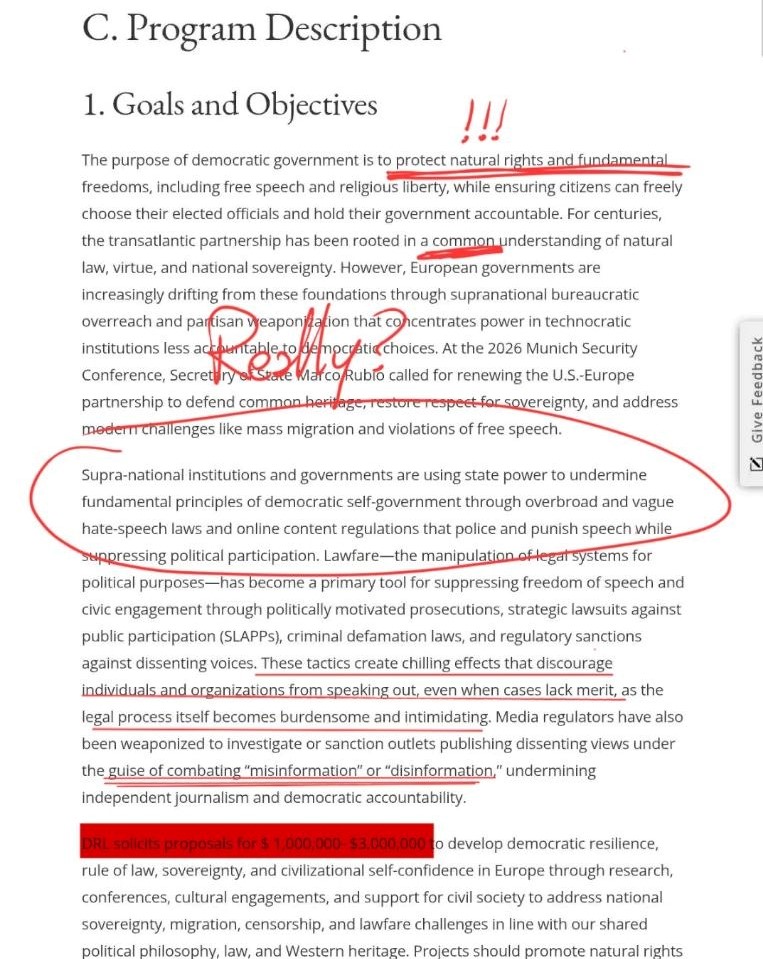
The Bureau of Democracy, Human Rights and Labour published a call for US-based and foreign organisations, and higher education institutes to ensure the survival of freedom of speech and press in Europe. The call starts as follows:
DRL requests proposals to strengthen and develop democratic resilience, rule of law, freedom of speech and freedom of the press, and the defense of human rights in Europe through research, conferences, cultural engagements, and support for civil society to address national sovereignty, migration, censorship, and lawfare challenges in line with shared political philosophy, law, and our common Western civilizational heritage.
The tender begins with what might seem a helping hand offered from a historical ally to a supposedly in-danger country, or in this specific case a union thereof, living through a dark period of its history.
Even though the juxtaposition of “free speech and free press” and the concepts of “shared political philosophy” and “common Western civilizational heritage” might sound confusing, this article will start by overlooking said combination.
Nevertheless, it cannot help but beg the question: is Europe actually facing such hard times in terms of basic democratic values? Is free speech being endangered?
Apparently so; according to the call, censorship has been taking over since the Digital Services Act came to pass in 2022.
The definition of censorship
On the internet, there can be as many definitions as there are aspiring authors, yet they all agree on some basic details: there is a body imposing the censorship, there are consumers who receive the censored product, and then there is the content being censored (may that be information, opinions or forms of expression).
Regarding the purpose of censorship, it is instead different: it can be to keep the population at bay, or to preserve it from self-harm. Based on this difference, philosophy divides itself between two approaches: utilitarianism and deontology. It is not the purpose of this digression to state which one better describes the European case, though the reader would be advised to detach themselves from whatever bias they might have towards the word censorship.
The Digital Services Act
When reading articles on Europe’s dictatorial decline, the light is usually fixed on one particular piece of legislation: the Digital Services Act.
In 2022, the DSA came to pass as a Regulation which implies its binding essence. Regulations were not carefully crafted in 2022-EU, they were here before and will be long after; so it would be safe to say that the European Union did not menacingly force its members to oblige. Furthermore, the regulation was indeed adopted by the EU Council and Commission during a democratic process, when it could have been refused had that been the general consensus.
Ultimately, the DSA does not condemn hate speech, but fights illegal content.
It is the Framework Decision 2008/913/GAI that defines hate-speech as out-lawed: fourteen years before the DSA.
What is happening in Europe versus the picture the US is pushing
Europe is fighting illegal content through censorship and fines; and in doing so, it has asked digital platforms and other intermediaries to introduce tools to prevent said crimes from happening and thus being shared, in the same way it has asked digital platforms to be more transparent towards their users and their data. Whether you should consider these actions as limitations on basic freedoms or not, isn’t up to me to say.
However, according to DRL, Europe is instead failing its democratic values and principles, being influenced by an unknown agent, lurking in the dark, either inside or outside its borders. Natural rights and fundamental freedoms are endangered by “technocratic institutions less accountable to democratic choices” and people are being silenced through “vague hate-speech laws”. Having made this clear, the Bureau is open to grant millions of dollars to any eligible candidate with the goal of spreading knowledge on Western heritage, the risks of immigration and how to spot episodes of harassment or jurisdictional overreach. Far be it from me to question why the US is more worried about us EU-citizens and our welfare while their country has fallen off several places on the Reporters Without Borders World Press Freedom Index. After all that would be a sterile response, which would not aid the conversation.
However, I do mean to question the integrity of said tender to fight off any attack at basic freedoms while expecting the proposals to be in line with a specific political ideology in order to be able to receive the grant.
Is that what freedom of speech means on the other side of the Atlantic? If so, it would finally start to make sense why they were also the ones shouting for censorship on this side of the globe.
Who has applied that we know of?
In Italy, a rather notorious web page called Welcome to Favelas has openly shared their will to apply to the call.
Disregarding the blatantly racist name of a page born to share episodes of violence and decline all over the “Bel Paese”, it is today claiming to be an independent, away from mainstream media and fake news, grassroots media outlet.
Change is possible, whether it is about ourselves or the world around us. I cannot comment on the page independence, or the social background of its admin; I can, however, comment on whether its news is well documented or not.
On the 28th of July, it was posted how the process of Islamification of Italy kept proceeding by sharing a collaboration in the city of Rome between the Islamic community and a local swimming pool. Said episode, based on what the page posted on its social media, consisted of an unspecified number of days with an unspecified number of hours during which the swimming pool would be open only to women. The post ends with a question on whether public funds were used to make such collaboration possible. The following day, “Welcome to Favelas” shouted on social media about how, firstly, their previous post trended, which supposedly made possible a reaction from politicians, and then how mainstream media, instead of fighting this attempt at segregating women in public spaces, interviewed the “delirious” President of the Islamic Community of Rome. Ending the whole post by self-proclaiming themselves as “the most useful tool to get the Italian citizens’ problems to politicians”.
After the reading, and a five-minute search online, I found several articles, older than WtF’s last post, debunking the whole situation.
The pool is open everyday of the week except for Sunday, from 7.30 to 21.30, for a total of eighty-four hours a week (three hundred and thirty six hours a month) of which, every Wednesday of August, from 7.30 to 9.30 and from 18.30 to 20.30, only women, after paying a fee of 40 euros, would be allowed entrance. Ultimately consisting of four hours per week, sixteen per month, it would be open only to women.
If this does not fall under the definition of fake news, it is certainly misleading and thus bad journalism. Their wording is full of biased rhetorical devices, the gaps in their information seem to be intentional, in line with an imaginary scenario they are continuously trying to push on their viewers; and as if this wasn’t enough, the call to save women, from what they called an attempt at segregation, can only be described as poor cognitive skills.
Cogito ergo diffido
With the hope of not being accused of being partisan, I do wish to point out the lack of coherent actions regarding the United States of America and their announcement. They shout for censorship in Europe while requesting project proposals that align with a specific ideology. They focus on the DSA as the source of said censorship, even though it has no actual role in it; instead, it enforces rules that safeguard European citizens’ data and information, which ultimately limits the economic benefits the digital services’ owners might have had, some of whom have close ties with the US Government and Donald Trump himself.
Finally, having Welcome to Favelas, the same who met with Elon Musk’s representatives last year, openly endorse said call to action, certainly does not help the case.
Having said all that, Europe is in for a ride with its most vulnerable people being the ones to look out for, and the ability to influence the masses, whether it is with truth or not, being the deciding factor.
We wait for October to see the first projects being enacted.
Sources
- U.S. DEPARTMENT of STATE (July 13, 2026). DRL NOFO Developing Civilizational Bonds, Democratic Resilience, and Rule of Law in Europe
https://www.state.gov/drl-nofo-developing-civilizational-bonds-democratic-resilience-and-rule-of-law-in-europe/ - FREEDOM RESEARCH (March 27, 2025). Censorship in the EU: Hate Speech Laws Are Suffocating Free Speech.
Censorship in the EU: Hate Speech Laws Are Suffocating Free Speech - NumberAnalytics (June 17, 2025). Philosophy of Censorship – Examining the ethical and moral dimensions of censorship in society.
Philosophy of Censorship - MAPTHOS (February 2, 2026). Mapping Online Censorship in Europe and the UK in 2025
Mapping Online Censorship in Europe and the UK in 2025 | MAPTHOS Blog - Reporters Without Borders. Index | RSF
- European Union. EUR-Lex (October 27, 2022) Regulation (EU) 2022/2065 of the European Parliament and of the Council of 19 October 2022 on a Single Market For Digital Services and amending Directive 2000/31/EC (Digital Services Act) (Text with EEA relevance).
Regulation – 2022/2065 – EN – DSA – EUR-Lex - European Union. EUR-Lex (December 6, 2008). Council Framework Decision 2008/913/JHA of 28 November 2008 on combating certain forms and expressions of racism and xenophobia by means of criminal law.
EUR-Lex – 32008F0913 – EN – EUR-Lex
Great
Wonderful
Congratulazioni
Bravo, complimenti
Complimenti
Bravo
Bravissimo
Congrats
Complimenti..🔝🔝🔝