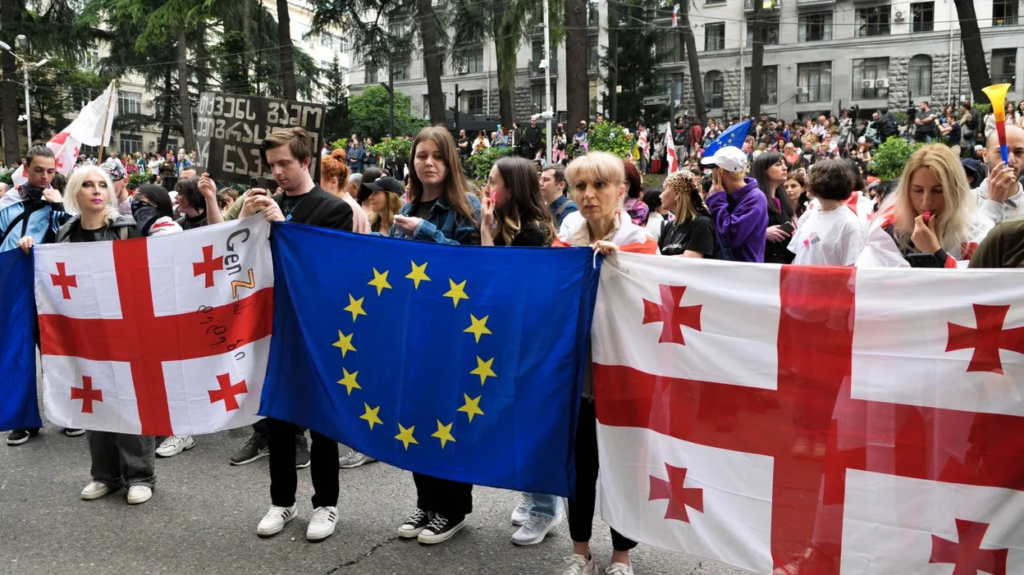
Just as many Georgians were about to end celebrations of their Orthodox Easter, in the evening of the 12th of April, they happened to receive a valid reason to prolong them. One election had officially put an end to Orbàn’s 16 long years of uninterrupted anti-democratic rule. The Tisza party’s landslide electoral win resonated as a message of hope for Georgia’s civil society, which had been fighting the illiberal tendencies of the ruling Georgian Dream. But are the hopes of the Georgian people well placed?
Just like in Georgia, elections in Hungary were held in a context of advanced democratic backsliding, dictated by Orban’s whim to modify the Constitution as he pleased, thanks to his constitutional majority in Parliament. Despite all of this, Magyar, a former Orbàn-loyalist succeeded in conjuring up support for his Tisza party in the space of two years. No Hungarian would have bet on the existence of such a rock-solid popular support for an alternative to Fidesz nor on the political will to actualize the power move. The sweeping success of the Tisza party served as the glaring proof that, despite all the electoral irregularities, manipulated electoral laws and gerrymandering, a unified and coordinated opposition force was all that was needed to topple Orban.
Many analysts have pointed out the multiple contact-points between the two countries, while giving a skeptical assessment as for the likelihood of something similar happening in Tbilisi. Just like in Hungary, Georgian political turmoil has been on the rise, ever since Prime Minister Irakli Kobakhdize announced the suspension of European Integration until 2028.
The social discontent has prompted 9 parties to join forces in an opposition alliance against the ruling party. The coordination document at the basis of this cooperation lays out a plan of action to peacefully dismantle the party’s “autocratic, criminal regime” through democratic means. The parties’ stated commitment is therefore to trigger a regime change to preserve Georgian Independence and Statehood. A coordinated approach against the status quo is in line with lessons from the Hungarian elections, where minor parties strategically refrained from running for seats altogether, to maximise votes for Tisza. The final decisive similarity that Georgia shares with Orbàn descending curve is its international isolation. Tbilisi has historically relied on Orban’s veto to shield itself from the European Commission’s constant threats to trigger sanctions or cut funds over the Country’s backsliding and its role as Russia’s preferred sanction evader. With the despotic leader now out of the Brussels’ game, Magyar’s willingness to re-acquire European funds makes turning its back to Georgia an acceptable price to pay.
While the contested president Salome Zourabichvili fuels the hopes of the Georgian people, claiming that “nothing saves a dictatorship” when “the patience of the public runs out”, analysts are not equally optimistic over a democratic turn due to the Georgian Dream new constitutional and electoral laws. In Hungary, Magyar could organise, campaign and win. The Georgian oppositions have been entirely stripped away of these rights. In late 2025, GD passed a legislative package that allowed the government to prohibit political parties “associated with the collective UNM” (the former ruling party). The ban also extends to individuals associated with the said parties and are therefore disempowered from running for office or joining any other party. A few months later, an amendment to the Election Code abolished all out-of-country voting, effectively disenfranchising Georgian citizens living abroad. They are estimated to account for about one third of the Georgian population and holding stark pro-Western and liberal democratic stances, which would severely endanger the ruling party.
The decisive differing element that saved democracy in Hungary while threatening its survival in Georgia is civil society. All throughout his 16 years of ruling, Orbàn was aware that removing his political opponents and choking pluralism would cost him way more than he could afford in terms of EU funds. Georgia’s case is strikingly different. By suspending integration, the Georgian government has already effectively renounced multiple sources of European funds, significantly reducing the leverage that the Union had over the Country. Free from any EU conditionality mechanism, the government was able to double down on the crackdown on civil society it had started years ago. In 2024, the “Law on Transparency of Foreign Influence” was passed which mandated all organisations receiving more than 20% of their funding from foreign sources to register as “agents of foreign influence”. With the 2025 “Foreign Agents Registration Act”, all those organizations receiving any percentage of foreign funding and failing to register as Foreign Agents are now liable to a prison sentence of up to 5 years.
To conclude, regime change in Georgia is incredibly unlikely, as the government in power has carefully taken all the steps to dismantle, brick by brick, all the elements that a coordinated democratic transition would need. Hungary’s history shows that a unified front can eventually break an illiberal system, Georgia’s current trajectory serves as a warning: no breathing space for civil society translates into a lack of political scope of action. Without the ability to organize, fund, or campaign, the Georgian opposition is left staring at a Budapest mirror that reflects a hope that, as things stand, they won’t be able to reach.
Bibliography:
- Georgia: Adoption of the new Foreign Agents Registration Act | OMCT
- Con la sconfitta di Orbán, cessa la protezione per il Sogno Georgiano? – Osservatorio Balcani Caucaso Transeuropa
- Hungarian Opposition Win Inspires Georgia’s Resistance as Ruling Party Loses Ally – Civil Georgia
- Nine Parties Unite in ‘Opposition Alliance’, Sign Strategic Coordination Document – Civil Georgia
- Georgia, caos elettorale – Osservatorio Balcani Caucaso Transeuropa
La legge sugli “agenti stranieri” in Georgia, spiegata