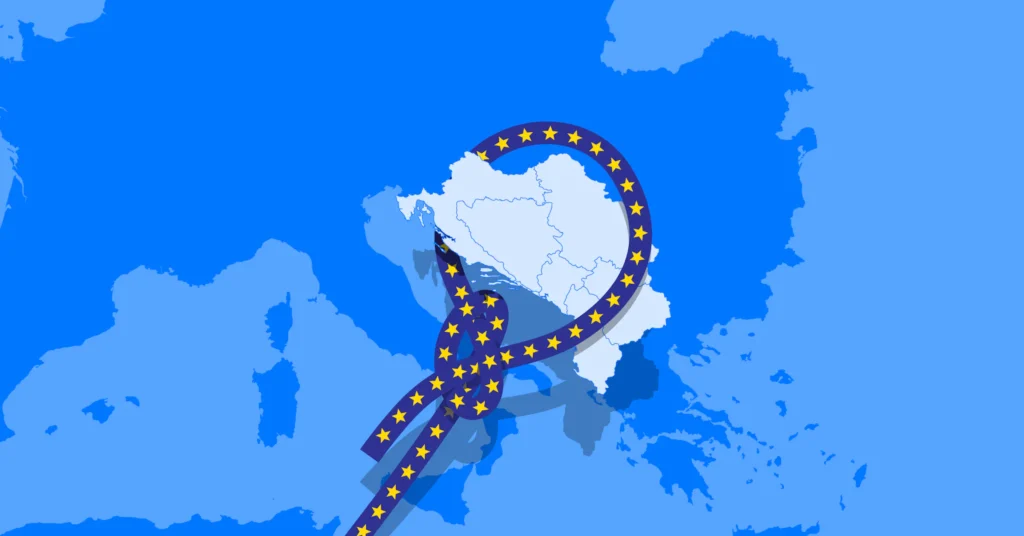
For three decades, the Western Balkans occupied an awkward position in Europe’s security imagination. The wars that followed the dissolution of Yugoslavia, combined with persistent governance deficits and the spread of organized crime networks, cemented in Brussels institutional culture the perception that the region was something to be stabilized, a source of instability to be managed.
The relationship with the Balkans was, in the EU’s mental geography, to be intended solely under the enlargement perspective, framing them as a recipient of security rather than a contributor to it.
That framing has become strategically costly since today’s EU’s demanding security environment due to: Russia’s full-scale invasion of Ukraine, prospects of US reduced commitment to the continent’s security, and geopolitical competition. Those aspects highlight critical gaps in European defence capacity and self-reliance, gaps that further Western Balkans’ involvement could partially fill. In this context, treating the region as a problem to be absorbed rather than a resource to be engaged is a luxury Europe can no longer afford.
But what if enlargement could be linked together with defence and security in order to fill those gaps?
The key to an effective enlargement process could lie in a significant involvement on the European defensive and security agenda.
The six Western Balkan partners — Albania, Bosnia and Herzegovina, Kosovo, Montenegro, North Macedonia, and Serbia — are already contributing, in concrete and measurable ways, to European security. The real question is whether the EU is ready to systematise and scale those contributions by integrating enlargement policy and defence policy more deliberately, and more urgently, than it has done so far.
Already in 2021, the Western Balkans had moved from a recipient of EU governance to an active contributor to it, for example, through regional cooperation frameworks, such as the “Police Cooperation Convention for Southeast Europe” and the “Western Balkans Counterterrorism Initiative”, which had progressively embedded EU operational standards into regional institutions.
In 2024, the Union signed strategic partnerships for security and defense with Albania and North Macedonia, which allow for the shared management of transnational challenges but, above all, collaboration between partners and the European Defense Agency (EDA), a relevant possibility especially in the eye of the EU rearm plan and the White Paper for Defence Readiness.
Today, the six Western Balkan partners are already contributing materially to European defence readiness across five distinct dimensions: defence spending and procurement, direct support to Ukraine, participation in CSDP and NATO operations, a functioning defence-industrial base, and strategic enabling infrastructure.
The spending figures alone are striking: The regional average defence expenditure reached approximately 2.06% of GDP in 2025 and several countries allocate between 20% and 30% of their defence budgets to equipment and modernization, meaning that resources are flowing into tangible capabilities development.
Procurement patterns, meanwhile, are increasingly tilting toward European suppliers, purchases that matter because they enhance interoperability with EU forces and open pathways for deeper industrial and training cooperation.
The industrial picture is perhaps the most underappreciated dimension of the region’s potential contribution to EU strategic autonomy. A legacy of Yugoslav-era self-reliance left the Western Balkans with a defence manufacturing base that is, frankly, remarkable for an area of its economic size: around 200 companies producing defence goods, with Serbia and Bosnia and Herzegovina accounting for the bulk of output and exports. Capabilities span small arms and large-calibre ammunition, artillery systems, armoured vehicles, and increasingly unmanned systems.
These manufacturers can produce to both NATO and Soviet standards; in the context of Ukraine’s sustained demand for Soviet-calibre ammunition, that dual capability is not a quirk of history, it is a strategic differentiator. BNT, a Bosnian producer, cites an annual artillery round production capacity of up to 500,000 units; Serbia’s state-owned enterprises — Jugoimport-SDPR, Zastava Arms, Krušik — export a wide portfolio, from howitzers and rocket launchers to armoured vehicles; Albania is at an earlier stage, building new domestic capacity across explosives, small arms, ammunition, and drones, including armoured vehicle production in a joint venture with the United Kingdom; Kosovo and North Macedonia are partnering with Turkish companies to develop ammunition, propellant, and drone ecosystems respectively.
The region has already demonstrated its willingness to translate this capacity into concrete support: Several Western Balkan countries have provided meaningful support to Ukraine in military, humanitarian, financial and diplomatic terms, especially in the early phases of the war; North Macedonia, for instance, transferred legacy Soviet-origin equipment usable immediately by Ukranian force; Montenegro contributed naval and artillery munitions; Kosovo, despite tha absence of formal bilateral recognition from Ukraine, supplied vehicles, ammunition and hosted training activities.
Western Balkans countries routinely contribute to EU PSDC missions: Albania and Montenegro supported EU training efforts in Mali; Bosnia and Herzegovina, North Macedonia and Serbia contributed to missions in the Central African Republic, Montenegro and Serbia added staff to the naval mission as part of Operation Atlante, and many more.
Geography is also a crucial factor: the Western Balkans form a land bridge connecting the EU core to both Ukraine and the Eastern Mediterranean, and for any scenario involving sustained European logistical support to Kyiv, or rapid force deployment to the southeastern flank, the region’s transport corridors, ports, and military installations are structural necessities rather than optional extras.
And yet, EU funding for military mobility in the 2021–27 programming period has, remarkably, not included South-East Europe, despite the strategic logic being, to put it plainly, overwhelming.
Infrastructure gaps persist, and this is precisely the kind of misalignment that a more deliberate integration of enlargement and defence policy could correct. The structural advantages of Western Balkans’ industrial base and its geographic proximity are straightforward: cost competitiveness is key, output can be priced below many Western equivalents and delivered more quickly to European end-users.
These are not marginal considerations since the EU’s 2025 White Paper on European Defence — the Readiness 2030 agenda — sets a target of producing at least two million large-calibre artillery rounds annually, a figure that will require mobilising every credible source of capacity on the continent; Western Balkan plants that already mass-produce 155mm shells and Soviet-calibre ammunition can help close that gap.
Defence policy and enlargement policy have for too long operated in parallel silos, each with its own institutional logic, timelines, and stakeholder communities. EU member states and institutions fail to capture the near-term strategic value that is sitting right in front of them.
To fully benefit from the region’s potential, the EU should consider Western Balkans as partners in defence, not just as candidates for enlargement. The Readiness 2030 agenda provides the clearest and most immediate entry point in this scenario, four of its priority tracks — large-calibre ammunition production, artillery systems, affordable drone and counter-drone capabilities, and military mobility infrastructure — map directly onto demonstrable Western Balkan strengths.
Integrating Western Balkans suppliers into EU joint procurement frameworks and facilitate their participation into financing mechanism of European defence, as the European Defence Industry Programme (EDIP), would be a practical and relatively low-cost step that could close real capability gaps within a timeframe that actually matters, while also bringing tangible benefits for local industries.
Additionally, a more integrated approach would treat defence cooperation as a distinct and visible track within the accession architecture, with its own benchmarks, access modalities, and reward structures. Early participation in EU standards, certification processes, and joint procurement would serve a dual function: it would accelerate acquis adoption, while giving candidate countries tangible economic and security stakes in alignment, in order to see the relationship as genuinely reciprocal.
The Security and Defence Partnerships that the EU signed with Albania and North Macedonia in are a genuine step in the right direction, but political frameworks require operational translation, concrete projects to deliver anything beyond paper commitments.
The transformation of the Western Balkans from security consumer to security provider is not a future scenario — it is a present reality that EU policy has not yet caught up with. The region already contributes to European defence readiness through its budgets, its industries, its operational deployments, and its geography. What is missing is the institutional architecture to systematise, scale, and reward those contributions in a way that serves both EU strategic autonomy and the long-term goal of full regional integration.
Completing the loop of European strategic autonomy requires treating the region as part of the solution, not as a problem still waiting to be resolved. That is not idealism. It is, at this point, a strategic necessity.