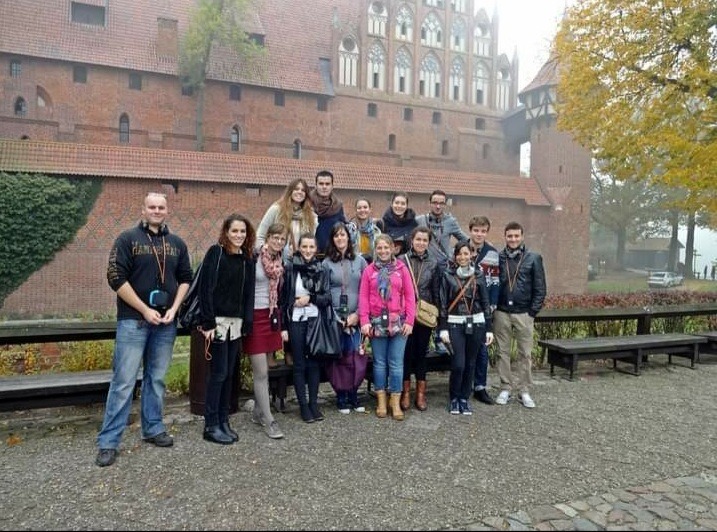
My name is Ana Maria Raluca Cojocaru, and in the following article I will describe the Erasmus+ experience in Poland for the university year 2012-2013. My study destination was University of Business and Administration (WSAiB) in Gdynia with a scholarship for the first year of Master studies at the Faculty of International Relations, Bucharest Academy of Economic Studies in Romania. The selection process for the 2012–2013 academic year was highly competitive. The qualification criteria included the 3-year Bachelor grades, English language competencies test and the interview with the Faculty’s representatives. Furthermore, the application required a resume, letter of intent and an argumentative essay on my field of study and the future perspectives upon returning to Romania. After being selected, it followed the fulfillment of all formalities imposed by the moving to a foreign country and the most anticipated moment: the flight ticket with destination Gdansk.
With all that said, on September 26th 2012, I landed in Tricity, Poland, Pomorze region. A truly unique metropolitan area formed by the three riverside cities in the Baltic Sea: Gdansk, Gdynia, Sopot. Gdansk is the historical capital of the region and the place where Lech Walesa’s Solidarnosc movement started, which contributed to bringing democracy to Eastern Europe. Gdynia is an academic center and a location for many music festivals and sport events; as well, it has a socio-economic importance due to its port and the afferent industry. Sopot is the most bohemian city between the three of them, first of all being a touristic destination. During my time living and traveling in Poland for my Erasmus academic year, I witnessed a process of development that included investments in infrastructure, education, and innovation, as well as the renovation of tourist attractions and the promotion of the country’s cultural heritage, all of which contributed to Poland’s reputation as a leading Eastern European nation. What I could learn from Polish culture is that the people are proud of their origins and that they respect their national symbols, that despite a cruel history, they recovered, rebuilding even a capital burned to the ground, that the fundamental values are family, work and respect for the other citizens.
At the university I had the chance to experiment a different learning model than the one in Romania; more open, based on argumentative discussions, practical study cases, presentations with feedback from the professors and colleagues. I could get to know people of different cultures, I succeeded at becoming more tolerant, more open towards novelty and more curious. I remarked that, besides the subject matter to be taught, the teachers wish to build consciences. I was not surprised by the good behavior of my Polish colleagues, involved and with initiative, who organized intercultural events such as ”Erasmus Anniversary Day”, ”Discover Europe Regional Gala”, ”International Buffet”, ”Far Away, but close”. In this framework, each of the Erasmus students represented the country of their origin with traditional culinary dishes, specific objects, photographs, presentations and movies. Visiting the most important tourist attractions from Warsaw, Krakow, Poznan, Torun, Hel and Westerplatte, the November 11th National Day Parade, as well as the events organized by the Erasmus Student Network are those thanks to I managed to get to know better the Polish culture, and the job fair held at the University and the volunteer work at the ”International Week – Master Studies abroad, chances on success” represented opportunities to be in the know about a professional career in Poland.
I also noticed some similarities between Romania and Poland, which is why there wasn’t much of a cultural shock: similar ex-communist pasts, similar traditional foods, and eco-friendly products. However, I think Poland is one step ahead, above all for how its own citizens view their nation. The conclusion I reached at the end of this journey is that the Erasmus scholarship was an experience of personal development and I’m delighted that I could form a European conscience and add value to my personal educational journey. Although it was difficult for me to depart from Poland, I chose to return home and try to contribute to the development of my own country.
As a participant in the Erasmus programme, I managed to consolidate my belief in the existence of a truly European citizenship. Networking with people of diverse nationalities allowed me to conclude that the differences between our cultures are slight compared with our similarities. We are shaped by evenly global events, we go through common intercultural experiences, and we become increasingly interconnected. I realised the importance of my national citizenship, as well as the value of unity and the sense of belonging to a European community. In this student exchange, I learned to appreciate cultural diversity and to accept that people can have different behaviours and expectations. I concluded that it’s very important to listen to each other, to show empathy, and build meaningful relationships. The intercultural events were an opportunity to better understand different cultures by listening, for example, to various stories beyond traditional foods, beverages and music. My ability to think and behave appropriately while interacting with people from various cultural backgrounds has improved. I recognized the value of having an accepting mindset regarding the variety of cultural expression.