
Since the 1970s, Europe has been facing a decline in its native population, and this decline stems primarily from two factors: fertility rates have remained below the natural replacement level of 2.1 births per woman, and an aging population structure.
This means that the population begins to decline, even if fertility rates are at or above replacement levels, and it is called negative “population momentum” (the number of deaths exceeds the number of births).
In the EU, these factors combined (declining fertility rates and ageing populations) could drive a 14% population decline by 2050 if left unchecked. Migration from outside the EU provides some counterbalance, as does increasing life expectancy. However, these positive contributions only partially offset the projected losses, resulting in an expected 5% overall population decline by mid-century.
Not all EU Member States are expected to experience population decline. Countries like Luxembourg, Ireland, Sweden, the Netherlands, and France are projected to continue growing. However, many Eastern Member States are already shrinking dramatically. Bulgaria, Lithuania, and Latvia have lost over 20% of their peak populations since the 1990s, with further declines expected.
Replacement migration can be defined as the volume of migrants needed to achieve specific demographic goals. This topic gained popularity at the beginning of the 21st century following the publication of the UN report. This report estimated the volume of migrants needed to offset the effect on population volumes and structures of low fertility and high life expectancy over the period 1995–2050 for eight countries (Germany, Korea, France, Italy, Japan, the United Kingdom, Russia, and the United States), as well as for Europe and the then 15-member European Union. Two of the main goals, maintaining the volume of the total population and of the working-age population, appeared feasible, while one was deemed impossible: sustaining the ageing process.
Currently, three regional patterns can be distinguished in Europe:
- Western and Northern Europe benefit from both types of migration—from outside the EU and from other Member States.
- Southern Europe (Italy, Spain) attracts non-EU migrants but experiences slight emigration to other EU countries.
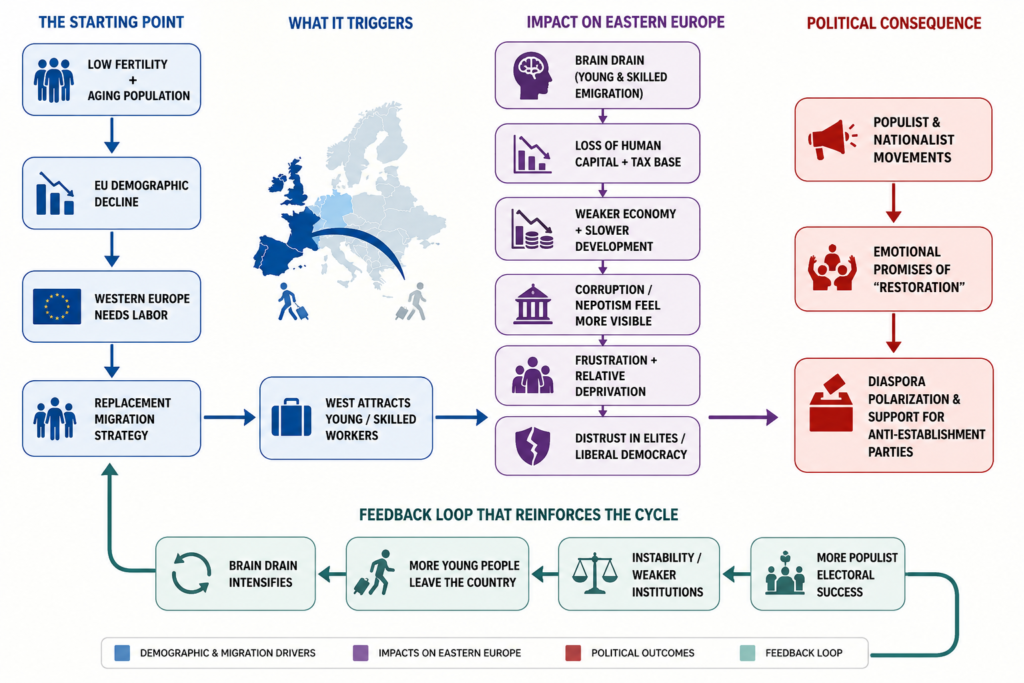
- Eastern Europe faces a demographic triple threat: low fertility, negative population momentum due to an aging population structure, and significant emigration to Western Europe. The migration of young, highly skilled workers from the South and Eastern Europe towards Western Europe has created an ethical dilemma: how long can that be sustainable for the countries of origin? This has been causing a structural problem for the affected countries: “The Brain Drain” phenomenon.
Brain drain refers to the permanent emigration or outflow of skilled and talented individuals from their home regions to seek better opportunities and prospects elsewhere. Addressing this phenomenon is crucial, as it negatively impacts the sending regions, lowering their economic growth and generating significant regional differences within the EU Common challenges and implications. The brain drain not only has economic consequences but also worsens regional disparities within the European Union.
The countries facing significant emigration of skilled professionals tend to fall behind their European counterparts in terms of economic growth, innovation capacity, and the country’s level of development. This disparity perpetuates the cycle of brain drain as individuals continue to seek better opportunities in more developed regions. As a result, the existing regional imbalances within the EU widen further, having severe implications for their goal of catching up with other European countries.
As the human capital theory suggests, migrants may be motivated by what has been referred to as ‘occupational upgrading’ rather than just taking a job with higher wages in another country. It implies that when emigrating, a young professional is looking for a country that appreciates, respects, and knows how to retain its employees (and usually countries with well-functioning democracies are leaders, such as Denmark, the Netherlands, Germany, and Sweden).
From recent studies, it has been concluded that widespread corruption and nepotism are the main causes of migration and the root of relative deprivation (individuals or groups experience relative deprivation when their aspirations are blocked by societal conditions, leading to feelings of discontent), which makes it impossible for young, talented graduates to grow as professionals.
Does Health Democracy influence the new ‘citizens of the West’ and their voting behavior in their home country?
Emigrant communities from developing democracies experience a bigger desire to be active in the democratic process in their country of origin, especially if they reside in countries with solid democratic institutions. The elephant in the room is: will the new diaspora vote for liberal parties, or more conservative ones, in their home country? And can the education factor play a bigger role than we had previously thought?
Well, here comes the paradox. It might be possible that a highly educated Romanian will leave his country to work abroad in a liberal, functioning democracy, such as Germany, but he will vote for a conservative party in Romania.
How is it possible that he rejects populism in the country in which he lives, but he encourages it in his home country?
I have conducted a small experiment, my main interest being the Romanian elections in 2024 and 2025, and the results were shocking: a majority of Romanian diaspora, who were previously not interested in the Romanian elections, have supported an extremely populist movement, AUR (with the main figures being George Simion and Calin Georgescu).
The study aimed to find out how social psychology and persuasive concepts can have real-life applications in a group. The collected data from interviews, observations, online analytics, and trend analysis showed that the main causes of the exhibited behavior are frustration, desire for change, and media propaganda that has been used to manipulate susceptible minds to ideological thinking.
Observing the group dynamics, I identified what are the main causes and needs of the group members. Here are my initial assumptions and what proved to be true or not.
- The first assumption was that Simion’s voters are pro-communism. Instead, they thought that by voting with the populist party, they would regain the path of democracy, which in the last few years had not been transparent at all and led to people’s dissatisfaction and distrust in the system.
- The second assumption was that all of Simion’s voters lack higher education. Instead, people with higher education voted for him too, but what I observed is the lack of connection between Simion’s voters with higher education and without (a kind of hierarchy).
- The third assumption was that all of Simion’s voters are old people. Turns out that most people who voted for him are middle-aged men (majority 44-54). The old population was divided: those who acknowledged Simion’s affirmation as being Russian-influenced, and those who did not or were approving of that.
- The fourth assumption was that voting behavior was exclusively frustration-driven. Decisions were made on an emotional basis.
Studies on the socioeconomic profile of populists’ supporters have been gaining popularity, and that is because the increasing geopolitical instability has forced a lot of young people out of their country.
Often, emigration is a result of more structural problems, such as economic crisis, shutdown of labor market sectors, or failure in governance. Therefore, that is how the feelings of distrust towards political elites, nostalgia for the old, good times are created.
The resentment of a ‘stolen life’ creates a fertile ground for populist movements, which appeal to the emotional side, and know exactly what the collective frustrations are. They claim purification of democracy, reduced inflation, cheaper houses, re-industrialization of the country, and other ‘dreams’ that have no actual sense without a real restructuring of the democratic institutions.
- Botev, N. (2012). Population ageing in Central and Eastern Europe and its demographic and social context. European Journal of Ageing. Available at: https://link.springer.com/article/10.1007/s10433-012-0217-9#Sec6
- Docquier, F., & Rapoport, H. (2024). Immigration and Right-Wing Populism: The Vicious Circle of Xenophobia. Paris School of Economics. Available at: https://www.parisschoolofeconomics.eu/app/uploads/2024/12/Immigration-and-Right-Wing-Populism-The-Vicious-Circle-of-Xenophobia.pdf
- EBSCO. Social Movement Theory: Relative Deprivation Theory. Research Starters. Available at: https://www.ebsco.com/research-starters/social-sciences-and-humanities/social-movement-theory-relative-deprivation-theory
- European Commission. (2023). Strategic evaluation of the technology transfer and IPR protection systems of Bulgaria, Croatia and Romania. Available at: https://op.europa.eu/en/publication-detail/-/publication/d4306bf8-2a65-11ed-975d-01aa75ed71a1/language-en
- European Commission. (2024). Fertility and migration, and population decline – The EU at a demographic crossroads. Knowledge4Policy. Available at: https://knowledge4policy.ec.europa.eu/story/fertility-migration-population-decline-–-eu-demographic-crossroads_en
- European Commission. Brain Drain: Are European countries losing talent? Horizon Policy Support Facility. Available at: https://projects.research-and-innovation.ec.europa.eu/en/statistics/policy-support-facility/brain-drain-are-european-countries-losing-talent
- European Commission. PSF Country Reviews and Implementation Plans. Horizon Policy Support Facility. Available at: https://projects.research-and-innovation.ec.europa.eu/en/statistics/policy-support-facility/psf-country
- European Students’ Union (ESU). Transforming brain drain into brain circulation in South-Eastern Europe. Available at: https://esu-online.org/policies/bm77-transforming-brain-drain-into-brain-circulation-in-south-eastern-europe/
- European University Institute (Cadmus). Political behavior, long-distance nationalism, and mobilization of highly skilled emigrants. Available at: https://cadmus.eui.eu/entities/publication/f52632be-a162-5d35-b1c3-039f923e6062
- Max Planck Institute for Demographic Research. Replacement Migration. Demographic Research, Vol. 40. Available at: https://www.demographic-research.org/volumes/vol40/45/40-45.pdf
- Peltoniemi, J., et al. Transnational Turnout: Determinants of emigrant voting in home country elections. Available at: https://www.researchgate.net/publication/338486681_Transnational_Turnout_Determinants_of_emigrant_voting_in_home_country_elections
- Umpierrez de Reguero, S., & Jakobson, M. (2023). Explaining support for populists among external voters: between home and host country. European Political Science Review, Cambridge University Press. Available at: https://papers.ssrn.com/sol3/papers.cfm?abstract_id=4256618