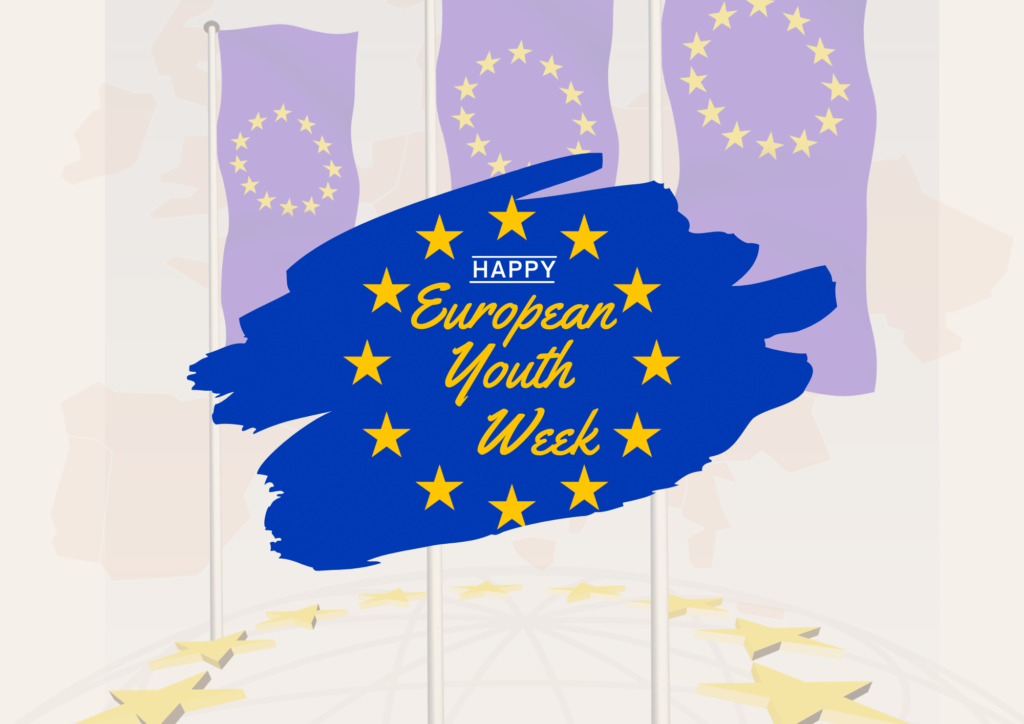
Organized by the European Commission, the European Youth Week is an event meant to promote and together celebrate youth engagement, participation and active citizenship Europewide and even beyond.
This year’s edition took place from April 24th to May 1st 2026, with a specific focus on celebrating 30 years of volunteering in Europe, with the kick-off in Brussels but celebrated in all the EU countries thanks to the activism and commitment of local NGOs.
The European Youth Week exists because people are advocating for youth rights, inclusion, and active participation in social life. It can therefore be described as an event that shows what European programs such as ESC and Erasmus+ mean for young people, highlighting the vital role they play in today’s society. There are various initiatives open to young people at the European level. The Erasmus+ program is the main example of how possible and important it is to grow, learn, make mistakes and, in turn, teach others when involved in an inclusive and stimulating environment. It is not limited to formal school and academic education alone, but opens the doors to a much wider audience, involving young people aged between 14 and 35 – according to EU criteria – and engaging them in a multitude of learning programs within the non-formal and informal education sectors. These range from Youth Exchanges, whose primary aim is to encourage intercultural dialogue and the development of soft skills through international and intercultural youth mobility, to Training Courses, which also pave the way for greater professional development through participation in workshops and interactive sessions aimed at acquiring skills that can be applied in a workplace. Then, there are the Partnership Building Activities and dialogue initiatives with policy makers. These are projects designed to provide new skills, to deepen knowledge for sector experts in other cases, and to offer the opportunity to step out of one’s comfort zone and embark on an entirely new path, one that seeks to move away from an increasingly exclusive approach and towards the greatest possible inclusivity. A further incentive is that the costs of food, accommodation and travel expenses are covered by funds allocated by the European Union for each participant. In particular, one of the program’s Youth Goals is to reduce the gap caused by geographical, economic and social barriers, as is the case respectively for young people from rural areas, those on low family incomes and those with various types of disabilities. To achieve this, it is therefore necessary to promote mobility so that it can reach an ever-increasing number of young people and be equally accessible to them, whilst also supporting it through a program that is increasingly aligned with these objectives from a dynamic and forward-looking perspective. Among other things, this translates into the need for a budget that is adequately proportionate to the ever-growing demand for participation from young people motivated by a desire for change. Equally important is the ESC program, albeit with a different focus. In this case, we talk about a program open to people aged between 18 and 30 and enabling young Europeans, as well as those from third countries such as Georgia, Jordan and Turkey, to undertake voluntary projects abroad for a minimum of two weeks and a maximum of twelve months. The themes range from civic engagement, through environmental sustainability, culture, art and education, to areas such as water management and support for refugee communities. This offers the chance to gain experience abroad, with all expenses – food, accommodation and pocket money – covered in this case too. In both cases, these are programs designed to encourage youth mobility, with a view to growth and development at the European level.
This marks the start of an educational process that opens the door to new experiences, fostering not only the acquisition of traditional knowledge but also skills relating to active citizenship, democratic participation, intercultural dialogue and emotional intelligence, thereby offering the opportunity for growth on two sides: placing equal importance on personal, emotional and cognitive development as well as professional development. A first step involves organizing awareness-raising campaigns on social issues, such as climate action, discrimination, digital literacy and mental health in the areas from which youth come, so as to raise collective awareness and start a dialogue with local authorities, ensuring a significant and positive impact even in the most disadvantaged areas. The scope then broadens through activities involving direct meetings, consultations and debates between young people and decision-makers, not only at the local level but also at the national and European levels. This means that democratic participation is not limited to the exercise of the right to vote alone – which remains, in any case, an important element in a modern and constantly evolving society – but also allows people to influence public debate and the decisions taken within and for a given community in an even more direct way. Schools and universities are no exception either, becoming genuine hubs for young people through the establishment of forums for dialogue, such as student associations and councils. In this way, efforts are also made to safeguard the right to education by demanding services and support where they are lacking – such as public transport for students, housing services and cultural centers – as well as addressing current issues. On the one hand, the aim is to promote solidarity and inclusion while on the other to discuss social issues, so as to create increasingly inclusive spaces for dialogue aimed at bringing about change for the younger generations, who in fact represent the future of individual communities and, in a broader sense, of a mature and cohesive Europe.
For this to be possible, learning must not remain confined solely to the period of participation in European programs; instead, there must be an increasing focus on sharing knowledge even after the programs have ended. It is, in fact, good practice to disseminate the knowledge gained, applying it in one’s own working environment, as well as in educational and personal contexts, whilst also seeking to raise awareness among young people who are still unaware of it or have not had the opportunity to access it, thereby creating a genuine multiplier effect that spreads over time, without fading but constantly finding new resources, including to adapt to the ceaseless changes affecting the societies in which we live.
In conclusion, European Youth Week is a significant event that aims to further highlight the importance of young people as ambassadors of a new and more mature set of values that can lay the foundations for evolutionary and innovative progress at the European level.