Neighborhood Policy to Geopolitical Frontline
Prague, in May 2009, leaders of the EU and six post-Soviet countries met to launch something modest: the Eastern Partnership. Armenia, Azerbaijan, Belarus, Georgia, Moldova, and Ukraine were offered closer ties, more trade, and one day, easier travel to the bloc. The Europe of 2009, faced with enlargement fatigue, was not offering membership; Brussels was divided over whether the partnership could become a stepping stone to membership after the fatigue passed. Russia was wary of the program from the beginning, seeing it as “the West” encroaching on what Moscow considered its sphere of influence.
Seventeen years later, the picture is unrecognizable. Every country in the Eastern Partnership (EaP) has seen conflict; Europe has become more polarized yet more open to accession; and Russia is more hostile than ever. In October 2026, Ukraine and Moldova opened two more blocks of EU accession talks. Georgia, the region’s star in Brussels’ eyes, has frozen its own bid for accession. Belarus has walked away from the partnership. Azerbaijan is helping Russia evade energy sanctions. Armenia, which had been Russia’s closest ally in the South Caucasus, has passed a law to start an EU bid.
So what happened to the Eastern Partnership? How did its ambitions of a stable neighborhood vanish? And what does that tell us about European institutions & capacity for peacebuilding?
***
Poland and Sweden proposed the idea in 2008. That August, Russia’s war with Georgia had shown how fragile the region was. The EU wanted a stable, friendly neighborhood to its east, but the enlargements of 2004, 2007, and the Eurozone crisis strained the EU’s institutional machinery, budget, and decision-making processes, leading current members to feel that the Union had expanded too far, too fast. Instead, Brussels set up a “more for more” deal, where the more reforms a country made on democracy, the rule of law, and the economy, the more it would get in trade access, funding, and mobility. While Warsaw saw the program as a waiting room for potential candidate countries once enlargement fatigue wore off, Paris and other Western capitals were unconvinced and strongly opposed to Ukrainian membership in particular. The compromise meant the partnership would be limited to ensuring a stable, prosperous neighborhood aligned with European standards, which opened the door to comprehensive trade agreements in the future.
These modest ambitions had a blind spot. Moscow long saw both Eastern Europe and the South Caucasus as regions in its sphere of influence, and it had a rival offer: The Eurasian Economic Union (EAEU). Launched in 2010 after years of talks, the customs union became a free trade area in 2015, and joining it meant that a member could not also sign its own comprehensive free trade agreement with the EU. These countries, caught in between two giants, were now also caught between competing institutions, regional frameworks, and what soon would become competing trade blocs. For citizens of the six countries, these ties also meant choosing what future they wished for themselves and their posterity.
For three countries, the offer became concrete. Moldova, Georgia and Ukraine signed Association Agreements with the EU, including Deep and Comprehensive Free Trade Areas. These deals, fully in force by 2016 and 2017, opened the EU market in exchange for adopting many EU rules. The most visible change was travel. Moldovans have visited the Schengen area without a visa since April 2014, and Georgians and Ukrainians since 2017. About 2 million Ukrainians used the visa waiver in its first year and a half. For a student in Chișinău or Lviv, Europe stopped being a queue at a consulate and became a weekend bus trip.
The other three went different ways. Armenia had finished negotiating its own Association Agreement in 2013. Then, in September that year, President Serzh Sargsyan returned from a short visit to Moscow and announced that Armenia would join Russia’s customs union instead. The reason was security: Russia was Armenia’s only military ally against Azerbaijan, and Moscow had just agreed to a large arms sale to Baku. Armenia joined the EAEU in January 2015, which ruled out a free trade deal with the EU; it later signed a lighter partnership agreement, in force since 2021. Azerbaijan, rich in oil and gas, kept relations focused on energy. Belarus never went much beyond dialogue.
The turning point came in November 2013. Under pressure from Moscow, Ukraine’s president Viktor Yanukovych refused to sign the Association Agreement at the Vilnius summit. Moscow wanted Ukraine, the biggest prize in the region, in the EAEU instead. Hundreds of thousands of Ukrainians filled Kyiv’s Maidan square, many waving EU flags. The protests ended his rule, and Russia answered in 2014 by annexing Crimea and invading the Donbas. Ukraine signed the agreement anyway, as did Georgia and Moldova.
People had died in a protest that began over a trade agreement with Brussels. That should give Europeans pause: a dry document had become a symbol of dignity and freedom for people outside the EU.
Meanwhile, the six partners drifted apart. Armenia, relying on Russia for security against Azerbaijan, stayed in Moscow’s orbit. Azerbaijan preferred a business-like relationship built on gas. Belarus, a founding member of the EAEU and already tied to Russia in a “Union State”, broke away completely: after Alexander Lukashenko’s disputed re-election in 2020 and the brutal crackdown that followed, Minsk suspended its participation in June 2021. One framework for six very different countries was showing cracks.
Russia’s full-scale invasion of Ukraine on 24 February 2022 changed everything. Within days, Ukraine applied for EU membership, and Moldova and Georgia followed. In June 2022, Ukraine and Moldova became candidate countries, something unthinkable in Prague in 2009. Georgia received candidate status in December 2023. This was a deep shift in EU thinking. For years, enlargement had been treated as a slow, technical reward for reforms. Now EU leaders openly called it a strategic choice. They had learned that leaving countries in a grey zone between the EU and Russia did not bring stability; it invited aggression.
For Ukraine and Moldova, the Eastern Partnership had served its purpose as a waiting room. Their real relationship with the EU now runs through accession talks, not partnership meetings. Tellingly, the last EaP summit was held in December 2021, before the invasion.
Where things stand in 2026
Ukraine and Moldova are now deep in accession talks. The first block of talks, on the “fundamentals” of democracy and the rule of law, opened in June 2026. By 13 October, 24 of 33 negotiating chapters were open for both countries. In Moldova, voters returned the pro-EU Party of Action and Solidarity with a majority in September 2025, despite what the authorities called up to €350 million in Russian interference.
Georgia is the partnership’s saddest story. After a disputed election in October 2024, Prime Minister Irakli Kobakhidze announced that EU accession talks would be put on hold until the end of 2028. Mass protests followed, and several opposition leaders have since been jailed. The EU has cut political contacts and, in March 2026, suspended visa-free travel for holders of Georgian diplomatic and official passports. Brussels is now discussing whether to extend this to all citizens, even though around 80% of Georgians still support joining the EU.
Armenia is the surprise. Feeling abandoned by Russia when Azerbaijan ethnically cleansed Artsakh (Nagorno-Karabakh) in September 2023 and after numerous incursions into Armenian territory, Yerevan froze its participation in the Russian-led security alliance. In March 2025, its parliament passed a law calling on the government to begin the EU accession process. The first-ever EU–Armenia summit took place in May 2026. In June, Prime Minister Nikol Pashinyan’s party won re-election with almost 50% of the vote on a pro-Western platform despite election meddling from Russia.
But Armenia is still a member of the EAEU, and Moscow is making it choose. In April 2026, Vladimir Putin told Pashinyan that belonging to both the EU and the EAEU was “simply impossible by definition”. Pashinyan agreed the two were incompatible but said Armenia could pursue both “for now”, and that its citizens would decide when the time came. Over the summer and around the elections, Russia restricted imports of Armenian fruit, vegetables, mineral water, alcohol, fish and dairy, citing safety concerns. That hurts: Russia accounts for about 35% of Armenia’s foreign trade and takes almost 80% of its dairy exports. Pashinyan warned that the dispute could be “the beginning of the end” of the EAEU. In September, Putin went further, saying that Armenia’s EU law already amounted to a declaration of withdrawal. It’s important to note that Russia frequently uses import restrictions as a policy tool to put pressure on neighboring countries.
Azerbaijan is a partner on its own terms. The EU calls it a “valued and reliable energy partner”, and its gas now reaches Germany and Austria. In May 2026, EU foreign policy chief Kaja Kallas said the EU was open to a “more structured partnership”, while human rights remain a sticking point. Here, the limits of Brussels’ influence are seen clearly, as it chooses to ignore Azerbaijan’s appalling human rights record, ethnic cleansing, history of aggression, etc., in exchange for a stable source of oil and gas. Azerbaijan is also useful for Russia, since Russian crude, once refined in Azerbaijan, is suitable for exports to Europe, making the country a vital for both Russia evading sanctions and the EU, which can now claim it buys less Russian oil, despite evidence pointing to the contrary.
Belarus stays outside. The EU works only with Belarusian civil society, much of it in exile.
***
The EU now wants to change how countries join. In her State of the Union speech in September 2026, Commission President Ursula von der Leyen promised roadmaps for the most advanced candidates, including Ukraine and Moldova. On 6 October, the Commission followed with a plan called “Preparing for a wider Union”. It proposes “gradual integration”: candidates could join parts of the single market, EU energy and transport networks, research programmes and defence projects before becoming members. Ukrainians and Moldovans got a first taste in January 2026, when EU roaming charges were dropped for them.
There is a catch. Access depends on reforms and on following EU foreign policy and sanctions, and it “must remain reversible”. The plan also proposes new safeguards for future members, including a clause, valid for 15 years after joining, that could in extreme cases suspend a new member’s voting rights.
Is this the start of a multi-tier Europe? In part, it is the familiar carrot and stick. The EU has always tied rewards to reforms, and past newcomers accepted transition periods, such as limits on their workers’ freedom of movement after 2004. What is new is how long the waiting room could last and how many floors it has. A country could be inside the single market but outside the room where decisions are made, and on probation long after it joins. That looks less like a ladder and more like layers of membership. Additionally, the multi-tier Europe in contemporary discussion would also mean deeper integration within the bloc in more areas while leaving other members out, which is not up for discussion as related to this topic. The contrast with Moscow’s model is striking. The EAEU offers an all-or-nothing choice, as Armenia is now finding out. The EU is moving the other way, offering membership in degrees.
For countries under Russian pressure, early benefits beat waiting decades, as the Western Balkans have since 2003. The risk is that “gradual” becomes permanent, and “almost members” become a category of their own.
***
The Eastern Partnership was unable to stop the wars of 2014, 2020, 2022, and 2023 because it was not built for that. One government blocked Ukraine’s and Moldova’s talks for two years. The Western Balkans were promised a European future in 2003 and are still waiting. Every delayed promise makes it harder for the EU to ask for difficult reforms next time. Rewards for reform matter only to governments that want to join. With Georgia’s government, Azerbaijan, and Belarus, the EU’s tools are weak, and some of them, like suspending visa-free travel for everyone, could end up punishing citizens rather than leaders. The EU calls Azerbaijan a “reliable energy partner” while human rights stay unresolved. Critics see this as weakening the EU’s credibility as a promoter of peace and democracy.
The gap between what was promised and what happened showcases one of the problems of consensus-based action and European institutions broadly. The EaP was born out of Europe wanting a stable neighborhood but not wanting to lead countries on or promise them future accession. Its technical-based framework and limited scope allowed Russia to outmaneuver the EU in offering access to trade blocs to the member countries. The European Union itself has weak security measures, and though it wished to build security in the region through economic cooperation, the EaP failed by being constrained in its own scope & not allowing functional spillover between security and economic areas.
However, just because the EU’s foreign policy tools are few and weak, it does not mean that its actions are in vain, nor does it mean that it is not worth trying to bring peace, stability, and economic prosperity to its neighborhood. There are numerous signs that Brussels has learned this and is changing its approach. Since 2022, the EU has started treating enlargement as a strategic and geopolitical tool. Gradual integration now includes defence cooperation, military mobility and protection against hybrid threats, and access can be withdrawn. That suggests the EU knows that peacebuilding in its east needs security as well as markets. The open question is whether it can build that capacity while major decisions still need all 27 governments to agree.
What is the Eastern Partnership now?
Seventeen years on, the Eastern Partnership has not exactly failed, but it has been overtaken. It was built for a world where the EU could offer “everything but membership” and hope Russia would not object. That world began to end in 2013 and was gone by 2022. Today the six fall into three groups. Two candidates are negotiating to join (Ukraine and Moldova). Two countries are changing direction, Armenia towards Europe and Georgia’s government away from it. And two want only a deal (Azerbaijan) or nothing at all (Belarus’s government). One framework cannot serve them all equally. If gradual integration goes ahead, Europe itself may have layers too.
The bigger lesson is about who drives change. Again and again, it was citizens, not diplomats, who pushed their countries towards Europe: on the Maidan, in Moldova’s polling stations and in the streets of Tbilisi. If the EU wants its eastern policy to mean something, it must stay loyal to those people, even when their governments turn away. Success should be measured not only by how many chapters open in Brussels, but by whether that promise is kept.
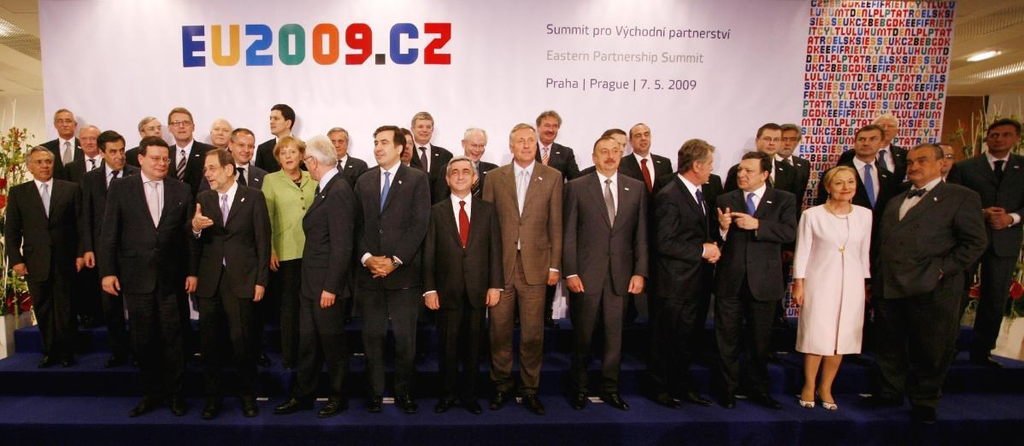
Photographer: Libor Fotjik © European Communities, 2009, licensed under CC BY 4.0