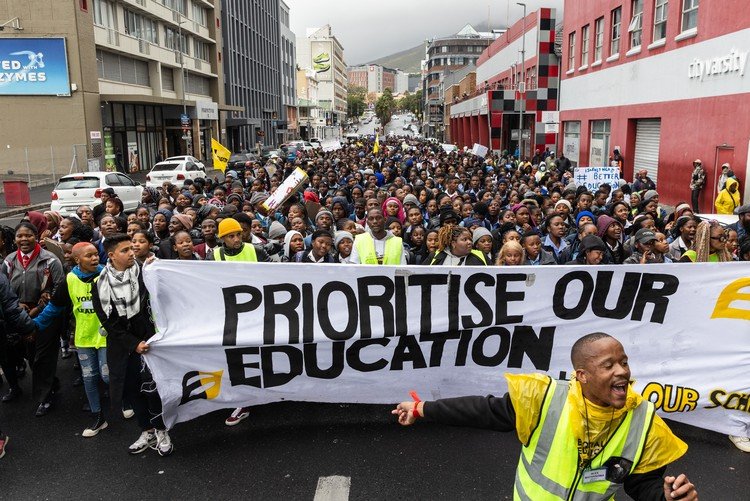
After decades of austerity measures that have been implemented across most of European countries, the rising cost of living, insalubrious classrooms, and failed education reforms, young people have taken to the streets of the main cities like Paris and Milan. But how did we get here, and why failure to provide a good education to younger generations can lead to a destructive loop?
Historically, improving literacy levels across one country’s demography has paved the way towards a healthier, richer society. Research by Emler and Frazer (1999) shows that people with higher levels of education are more active in politics, have clearer political identities, and understand how government institutions work. On the other side of the coin, unequal access to education feeds the ground for future anti-democratic sympathizers, political polarization, and social exclusion of minorities.
An interesting study case is the evolution of OECD countries (Organization for Economic Co-operation and Development). What they all have in common is the priority of heavily investing in education, which led to the creation of a workforce capable of solving high-stake tasks, and tackling modern day social issues, such as climate change, declining population, and economic pressure. But this is not a one-time investment, it is a commitment to operate as a pluralistic democracy that values individual liberty.
What happens when conservative governments take the lead and use the economic crise as an excuse to cut the budgets?
In this article, we are going to explore how Southern European countries like Portugal, Spain, Greece, and Italy have made a huge step back in terms of education quality, and how we can take lessons from North Europe or East Asian countries.
Throughout the 1990s, the main point on the EU political agenda was to create a sense of Europeanness and extend universal education access for every person, across all its members. Southern countries were more challenged for a multitude of reasons, such as later industrialization (with some exceptions), more fragmented societies, and deeper social inequalities across population. And so, for more than a decade, these countries, started to heavily invest in education, reaching impressing milestones, leading to a smaller gap between the rich Nordic countries, and the unlucky southern ones. By 2005, this priority subdued to the new political agenda and bigger aspirations have taken the spotlight. However, these countries continued to make small but sure progress, until the 2008 world crisis, that had a bigger impact on countries that were less prepared in terms of highly skilled workforce who could face the new imminent challenges. Even though there were attempts to continue with the education reforms, new austerity measures had stopped any of them and so began the decline. Research has shown that, regardless of the economic crisis and austerity measure reduction, initially, Southern European countries increased their performance in terms of education from 1990 to 2015. Nevertheless, these policies of austerity in education gave rise to several negative facts: the dismissal of teachers, school closures, and interruptions of educational programs. It is important to note that, during recent years, an important trend was noted across the four countries: conservative governments taking over. This change had an impact on the education agenda, and the new political rhetoric has favored selectivity across pupils, mainly affecting stigmatized minorities.
Can the increasing median age of a voter affect budget allocation?
Since the 1970s, Europe has been facing a decline in its native population, with the median age being 43 years, compared to, for example Africa, where the median age is 19 years. Now, that leads to a correlation: in a democracy, voters naturally push for what benefits them, and are actively looking for short-term benefits, rather than long-term objectives, such as education funds. That puts even more pressure on a young person that will have the deal with the burden of working to pay the pension for the double-sized retired population and will lack an adequate education that could prepare him to tackle such a challenge. Whenever birth rates drop, politicians love to use demographic decline as an excuse to cut the school budgets. Recent studies tell a completely different story: school systems are notoriously slow to adapt to changing student populations. Because total school budgets don’t shrink right away when student enrollment drops, the money that was supposed to go to those missing students gets re-channeled elsewhere in the system. The result? The overall cost of education per pupil automatically goes up.
The East Asian Way: A South Korean study
South Korea is a paradigm in itself: from one of the poorest countries in the world in the 1960s, to one of the richest and most industrialized today. But what drove Korea to this point, the human capital, is also shrinking the fastest in the world. In fact, the birth rates is approximately 0.7, meaning that a woman gives born to “less than a child”, and the future does not look bright, with recent estimations foreseeing a decline from 52 million people to half of it by 2100.Instead of using shrinking birth rates to justify budget cuts, East Asian nations treat education as a matter of national survival. While average government spending on education across the OECD has dropped, Korea increased its public spending (OECD, 2026). Because fewer future workers will have to support a massive aging population, Korea decided that every single child’s power needs to be maximized. What has to be accounted for when comparing Europe and Asia is that there are cultural differences that would make almost impossible the implementation of certain tactics that are used in South Korea in countries like Portugal or Italy. It is not a secret that Korean students undergo a high level of pressure, which heavily affects mental health. But there are also OECD countries performing even better, and that prioritize student wellness, as much as academic performance.
The Finnish Model
The Finnish education system, that undergone a complete restructuration since the 1970s, is now ranked as number 2 globally for highest-performing graduates in OECD studies. But what makes it unique are not just the numbers, but the values on which it stands: equality and inclusion, trust and teacher autonomy, student well-being, and cooperation over competition. In fact, pupils are educated in such a way that they develop intrinsic motivation to study, without unnecessary external pressure. Being a teacher is a highly respected profession, and only the best pedagogues make it to the classrooms.
Copy and paste or glocalization?
In the end, is there a concrete piece of advice for Southern European countries? That is hard to say, but what it clear is that there is something to learn from both the Korean and the Finnish model. Demographic decline is no longer an estimation, but reality, and the biggest resource a country has is its young, intelligent minds. If only they are educated in the correct way to be able to face worsening social issues, then a country can secure its future. But by doing so, it is also paramount to take into account the personal well being of each young person, and find practical ways to alleviate the burdens, and for that, the Finnish model has succeeded so far.
Sources
- Capucha, L., Sebastião, J., Martins, S. da C., & Capucha, A. R. (2016). Crisis and education in Southern Europe: The effects of austerity and ideology. Comparative Sociology, 15(5), 593–620. https://doi.org/10.1163/15691330-12341402
- Emler, N., & Frazer, E. (1999). Politics: The education effect. Oxford Review of Education, 25(1–2), 251–273. https://doi.org/10.1080/030549899104242
- Falch, T., & Rattsø, J. (1996). Political economy of public school expenditure: A study of local authorities in Norway. European Journal of Political Economy, 12(2), 301–319. https://doi.org/10.1016/0176-2680(95)00030-5
- Murariu, A. I., Constantin, A., Budu, R. A., & Frăţilă, B. M. (2025). The socio-economic costs of underfunding education: A multi-country case study approach. Proceedings of the International Conference on Business Excellence, 19(1), 3347–3359. https://doi.org/10.2478/picbe-2025-0255
- Organisation for Economic Co-operation and Development. (2026). Education at a glance 2026: Country notes – Korea. OECD Publishing. https://doi.org/10.1787/b4968bbc-en
- Sahlberg, P. (2021). Finnish lessons 3.0: What can the world learn from educational change in Finland? Teachers College Press.