
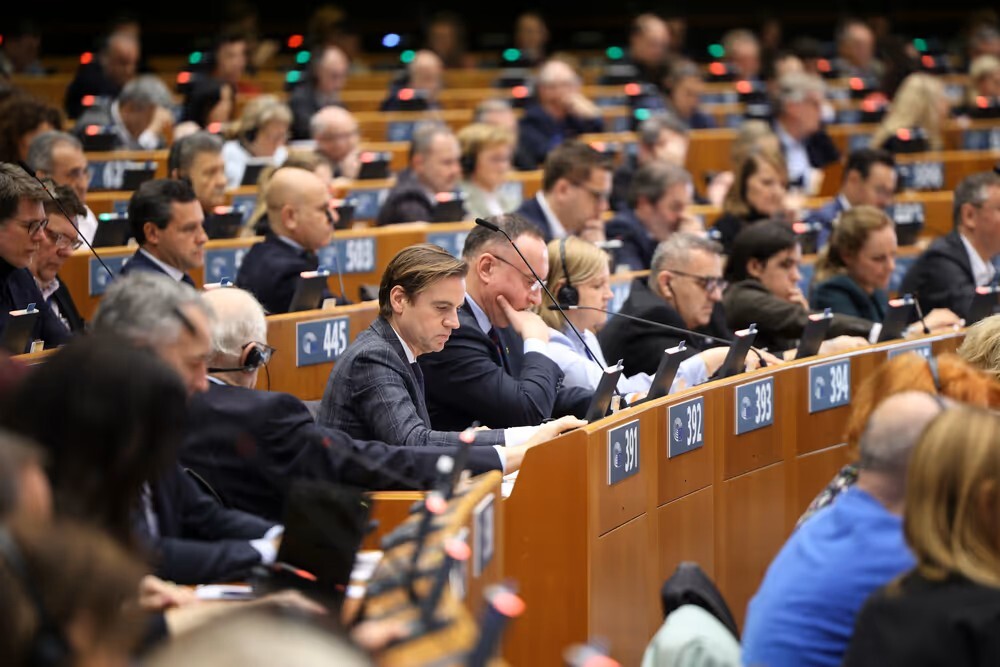
In March 2026, the European Parliament voted in favour of new migration measures allowing for the deportation of rejected asylum seekers to so-called “return hubs” outside the European Union. Presented as a necessary response to the growing pressures on the EU’s asylum system, the reform aims to accelerate returns, reinforce border control, and discourage irregular migration. However, beyond its administrative dimension, the measure raises a broader question: what kind of Europe is being shaped, and who is actually allowed to belong within it?
The European Union has long presented itself as a political project grounded in universal values such as human rights, solidarity, and openness. Nevertheless, when analysing its migration policies, a clear contradiction emerges. On the one hand, Europe claims to protect dignity and inclusion; on the other, it increasingly relies on deterrence and exclusion. As a result, migration is not only a matter of border management, but also a question of belonging and recognition.
The newly approved measures form part of a broader effort by the European Union to reform its migration and asylum system in response to long-standing political pressures. More specifically, building on proposals put forward by the European Commission, the reform seeks to make the return of rejected asylum seekers more efficient through faster procedures and stricter enforcement. Among its most controversial aspects is the possibility of transferring migrants to “return hubs” located outside EU territory.

Supporters argue that such measures are necessary to restore credibility to the asylum system. In particular, they emphasise the persistent gap between return decisions and actual repatriations, which has led policymakers to prioritise deterrence. In this view, stricter procedures and externalisation are considered essential tools to manage migration more effectively.
However, critics question both the effectiveness and the legitimacy of such policies. Human rights organisations have warned that relocating migrants outside the EU’s legal space risks weakening accountability and limiting the protection of fundamental rights. Under this aspect, migration governance appears not only as a technical matter, but as the result of broader political choices concerning control, responsibility, and the limits of protection.
First of all, it is important to underline how the European Union has historically defined itself. The EU is often described as a normative project built on dignity, freedom, and solidarity. These principles are embedded in its institutional framework and constitute a central element of its political identity. In this sense, Europe presents itself as a space where protection is guaranteed to those in need.
However, analysing recent developments, it becomes evident that these principles are not applied in a uniform manner. The growing emphasis on stricter return mechanisms and the externalisation of asylum procedures demonstrates that control is increasingly prioritised over protection. Although such measures are justified in terms of security and efficiency, they reveal a selective application of rights. Access to protection depends, to a large extent, on how migrants are perceived and politically framed.
Consequently, a contradiction emerges at the core of the European project. If rights are universal, their selective application inevitably undermines their meaning. In essence, migration policy becomes a field in which Europe’s values are not only expressed, but also limited and contested.
Secondly,and more fundamentally, migration should not be interpreted solely through technical or administrative lenses. Beneath these concerns lies the question of who is considered part of the European community.Decisions regarding entry, residence, and removal are not neutral; rather, they reflect assumptions about identity, membership, and belonging.The introduction of external “return hubs” clearly illustrates this dynamic. By relocating certain individuals outside the territorial and legal space of the European Union, such policies effectively place them beyond the boundaries of the political community. As a result, they reinforce a distinction between those who are perceived as belonging and those who are excluded.
Belonging in Europe, therefore, is not simply a legal condition. It is also a political and social construction shaped by institutions and discourse. Under this aspect, migration governance becomes a key mechanism through which these boundaries are defined and maintained.
A further aspect that emerges is the selective nature of European solidarity. While the European Union presents itself as a space of shared responsibility and humanitarian commitment, in practice solidarity appears conditional. It is shaped by political context, public perception, and strategic interests.
Recent developments have shown that Europe is capable of mobilising significant resources when there is political will to do so. However, this capacity is not applied uniformly. A similar logic can already be observed at the national level. In Italy, the government led by Giorgia Meloni has promoted agreements,first initiated in 2024, to transfer asylum seekers to processing centres in Albania. Presented as a practical solution to manage migration flows, these initiatives reflect a broader European trend towards externalising migration control. By relocating migrants outside the EU’s legal and territorial space, such policies raise familiar concerns about accountability and the protection of fundamental rights. At the same time, they illustrate how migration is increasingly approached not only as a matter of governance, but as a political question tied to control, deterrence, and the definition of who is allowed to remain within the European space.
Responses vary depending on how migrants are perceived—whether as deserving of protection or politically acceptable.
As a result, solidarity appears less as a universal principle and more as a selective practice. It is extended to some and withheld from others, reflecting broader narratives about identity and belonging. In essence, migration policy reveals the implicit hierarchies that structure inclusion within the European community.
Taken together, these developments raise broader questions about the direction of the European project. If migration policy increasingly reflects exclusionary practices, one must ask what this means for a Union that continues to define itself through universal values.
At stake is not only the management of migration, but the nature of the political community Europe seeks to embody. These policies shape whether Europe understands itself as inclusive or as a bounded community based on selective inclusion.
For many people living in Europe without full recognition, these tensions are not abstract. They are experienced through institutions and everyday interactions. As a result, migration debates are closely linked to broader questions of recognition, belonging, and identity.
What emerges, therefore, is that the recent shiftin European migration policy reflects deeper political choices about belonging and exclusion. As has been shown, while the European Union continues to present itself as grounded in universal values, its approach to migration reveals the limits of these commitments.
It must be considered that the increasing emphasis on control and deterrence risks transforming solidarity into a conditional principle. As a result, Europe is not only shaping migration outcomes, but also redefining its own political identity.
However, if Europe is to remain credible in its commitment to human rights and inclusion, it must confront these contradictions directly. This requires moving beyond policies based on externalisation and towards a more coherent and inclusive understanding of belonging.