Imagine Europe had to be invented in 2026.
One morning in a village near Cluj, a man called Popescu opens his window and finds a Dutch cow eating his roses. He doesn’t own a cow. He has never been to the Netherlands. He shrugs, and goes to make coffee. The beans came from Colombia through a port in Antwerp, the sugar is French, and his phone is buzzing on a network that covers half a continent without charging him for the border it just crossed. Popescu notices none of it. That is the first miracle. Not the cow. The shrug.
Later he goes to the supermarket. Into the basket go Italian mozzarella, Greek yoghurt, Belgian beer, Norwegian salmon, Swiss chocolate and a loaf of Romanian bread, because some things are not negotiable. He pays, walks out, and it does not cross his mind even once that he has just done a full lap of Europe with a shopping trolley. To him it is a Tuesday.
This is the strange thing about my continent. You can get on a plane, fall asleep, wake up, land, and the only proof you went anywhere is that the flight attendant now says welcome in a different language. When I was little I thought borders were walls. Then I grew up and discovered most of them are just blue signs, exciting for about four seconds and mainly useful for selfies.
And Europe is loud, and it smells of things. Rain on the canals in Amsterdam. A bakery breathing warm bread onto a street in Lisbon. An accordion in Paris that you would pay to make stop and then miss the second it does. A tram screeching round a corner in Vienna. A packed bus in Cluj where nobody has room and everybody makes room. A ferry pulling out of Helsinki into water the colour of a knife. Nobody planned any of it. All of it, somehow, works.
And the cast has changed in a way the founders never pictured. The mechanic is called Abdul. The baker is called Ahmed. The mayor is called Kowalski. The nurse speaks four languages and slides between them without noticing. The kid answers her in two. Nobody asks anybody where they are really from until the football starts, at which point everyone remembers instantly. The most European thing about us is not that we all speak English. It is that we all apologise in English.
Somewhere tonight, two students who met on Erasmus are arguing over whose grandmother makes the better soup. In twenty years their kids will call both recipes a family tradition, and mean it.
I should admit my bias. I am seventeen. I have never swapped francs for marks at a border kiosk. I barely remember roaming charges. To me, waiting days for a letter to arrive from another country sounds faintly medieval, like something you would do with a horse. My grandfather’s generation crossed this continent with a wallet full of different money, losing a little at every booth and stopping at every barrier. I cross the same distance with one card and a dying phone battery, and the only border I actually feel is the one where the coffee suddenly gets better.
People like to call Europe a museum. Beautiful, old, slightly finished. Somewhere you visit, photograph and leave. And fine, it is the largest open-air museum on earth, all castles and cathedrals and squares worn smooth by six hundred years of feet. But that word misses the strangest part. This museum is alive. People still live inside the paintings. History did not pack up and move on here the way it did almost everywhere else. It moved in, put up shelves and stayed. Romans, Ottomans, Vikings, Arabs, Greeks, Jews, Slavs, all layered into the same streets, and somehow the whole impossible pile still runs.
Which brings me to a question I cannot shake. We treat all of this like it is normal. It is not normal. It might be the least normal thing human beings have ever built. So try this. Imagine Europe does not exist. It is 2026, twenty-seven governments sit down with a blank page, and someone stands up to pitch the whole thing from scratch. How fast do they get laughed out of the room?
Picture the pitch. Someone stands up and says, I have a business idea. The room goes quiet. I would like twenty-seven countries to drop most of their border checks. Share a single currency. Let millions of their students go and live and study in each other’s universities. Accept the rulings of a court that sits above all of them. And when they disagree, which will be constantly, they should stay together anyway. Then he looks up and asks, any questions?
Open borders for four hundred and fifty million people, no passports, across twenty-nine countries, some of them not even members? In the middle of today’s migration wars, that idea would not survive the coffee break. One shared currency, so twenty-one countries hand over their money, printed with their own kings and rivers, to a bank they run together1? You would be called a traitor before you finished the sentence. And yet a kid in Bulgaria this year started buying lunch in the same euro as a pensioner in Portugal. We even agreed on a single phone charger before we agreed on almost anything else, which, if you know Europeans, might be the bigger miracle. We already did the impossible parts. We just did them so long ago that we forgot they were ever hard.
Here is the uncomfortable part. Try pitching that same room one last thing: trust. Just trust. Nobody invests. Nobody votes. Nobody signs. And yet trust is the only material Europe was ever really built from, and it was cheaper in 1957, when the men signing the papers in Rome could still smell the smoke. They had seen the other thing with their own eyes, a continent that had decided its borders were worth dying for. We have only ever seen the peace they left us, which is exactly why we keep mistaking it for the weather.
None of this makes Europe perfect. It argues too much, moves too slowly, and lets one stubborn government hold up the other twenty-six far more often than it should. But you do not burn down a house because the plumbing annoys you, especially a house you could never afford to build again. You fix the pipes. You keep the roof. And the roof, here, is the almost unbelievable fact that people who spent centuries killing each other now mostly just argue about football and cheese.
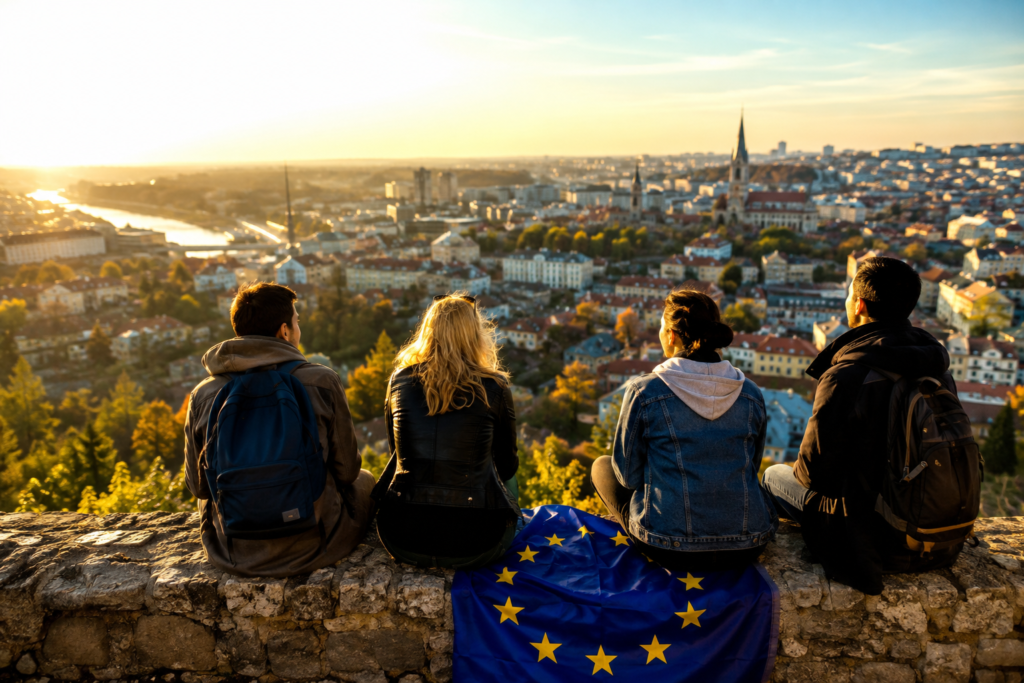
So maybe the greatest thing Europe ever did is not the flag, or the parliament, or the single market. Maybe it is this: we did not only erase the borders from the maps. We erased them from ordinary people’s imagination. Tomorrow morning Popescu will open his window again. The cow will probably be gone. He will make another coffee, answer another message from another country, unpack another basket from five of them, and never once think any of it is remarkable. And maybe that is the quiet miracle. Not that Europe changed our lives, but that millions of us stopped noticing it had. Perhaps that is what peace looks like, after long enough. Not celebration. Habit.
Sources
The euro is the official currency of 21 of the 27 EU member states; Bulgaria adopted it on 1 January 2026. European Union, “The euro”:
https://european-union.europa.eu/institutions-law-budget/euro_en
See also Council of the EU, “The euro: facts and figures”:
https://www.consilium.europa.eu/en/policies/the-euro-facts-and-figures/ and European Central Bank, “Our money”: