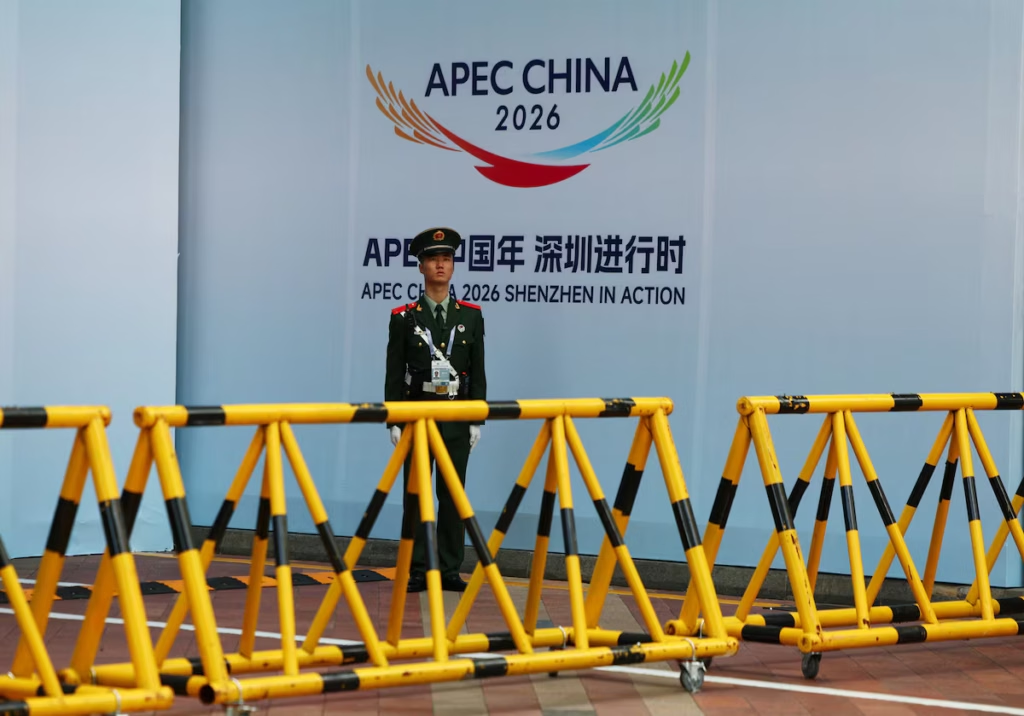
While world leaders gathered in Shenzhen for the 2026 Asia-Pacific Economic Cooperation (APEC) summit to discuss artificial intelligence, digital economies, and trade barriers, Russian President Vladimir Putin used the stage for a very different purpose: to mock the European Union. Speaking alongside Chinese President Xi Jinping, Putin declared that Europe is undergoing a “humiliating decline,” claiming the continent has lost its industrial capacity and global influence simply because it chose to sever its dependence on Russian energy.
Yet this was only the opening act. As the summit enters its second day and US President Donald Trump prepares to take the stage ahead of scheduled trilateral discussions with Xi and Putin, European capitals are watching closely. With topics like the war in Ukraine, nuclear arms, and global trade on the table, the central question hanging over Brussels is whether Trump will echo criticisms of European weakness, push transactional trade demands, or join a diplomatic choreography that increasingly resembles the 1945 Yalta Conference, where major powers carved up spheres of influence without the affected nations in the room.
When the world’s most powerful leaders meet to negotiate global security while openly treating Europe as a declining spectator, the EU faces a critical test of relevance.
The Illusion of “Cheap” Energy
Putin’s narrative in Shenzhen relies on a convenient distortion of reality. By pointing to Europe’s budget deficits, inflation, and industrial pressures, he argues that Western sanctions have backfired while claiming Russia has weathered the storm “with dignity.” Conveniently absent from his speech was any credible economic data proving that Europe’s structural challenges stem solely from energy decoupling, or any acknowledgment of the mounting strain inside Russia’s own war-distorted economy, where military spending masks deep structural vulnerabilities and persistent inflation.
This projection of invulnerability becomes even harder to sustain when contrasted with realities on the ground. As Moscow tries to dictate terms from a position of strength on the diplomatic stage, critical Russian military logistics and flagship symbols of its occupation, such as the Kerch Bridge connecting Russia to Crimea, have proven increasingly vulnerable to Ukrainian strikes. Stripping away the propaganda, the Kremlin’s bravado in China looks less like a victory lap and more like an attempt to project leverage before high-stakes negotiations begin.
The Danger of an Empty Chair
The real threat to Europe does not lie in Putin’s insults, nor in his hypocritical calls for a world based on “equality, not hegemony” while Russian troops remain on Ukrainian soil. The real danger lies in the diplomatic choreography surrounding the Shenzhen summit.
Given the US administration’s frequent criticism of European trade surpluses and defense spending, any alignment in rhetoric between Washington and Moscow regarding Europe’s perceived decline would send a chilling signal across the Atlantic. If Washington, Beijing, and Moscow sit down to discuss the future of Ukraine and the broader architecture of international security without a unified European voice at the table, the Yalta comparison stops being a historical metaphor and becomes a geopolitical reality. For decades, the European project was built on the promise that the continent would never again be a chessboard for external empires. Yet internal fragmentation, slow decision-making, and over-reliance on external security guarantees have left the EU vulnerable to being sidelined when the stakes are highest.
A Wake-Up Call for European Autonomy
For young Europeans and citizens across the Union, the scenes from Shenzhen should serve as a stark wake-up call rather than a reason for despair. A continent of 450 million people, possessing one of the world’s largest single markets, leading research institutions, and deep democratic traditions, is only irrelevant if it chooses to act like it.
Mockery from autocrats is nothing new; they have predicted the collapse of European democracy for decades. However, proving them wrong requires more than strongly worded press releases from Brussels. It demands genuine strategic autonomy, faster political integration, and the courage to invest in our own defense, innovation, and industrial competitiveness.
Europe cannot control what is said behind closed doors in Shenzhen. What it can control is whether it remains a divided collection of middle powers waiting to hear what others have decided for them, or whether it finally steps up as a unified geopolitical actor capable of writing its own future.